Dive slate · divesites.com.au · printed 7 Nov 2026
Balls Pyramid – Observatory Rock
Lord Howe Island, New South Wales · near Lord Howe Island (Lagoon Road boatsheds)
| Depth | 5–28 m |
|---|---|
| Minimum level | Advanced Open Water |
| Difficulty | Advanced |
| Access | Boat (day trip) |
| Entry | Live-boat drop (giant stride or backward roll) onto the site; free or shot-line descent; SMB and free ascent |
| Current | Variable/Tidal |
| Visibility | 30-45 m |
| Water | summer 23-26 °C, winter 17-20 °C |
| Suit | 5 mm full suit in summer–autumn; 5–7 mm with hood or a semi-dry from June to October |
| Best season | September–June (the dive shop's main season); February–May for the warmest water and most settled seas |
| Bottom time | 45 min |
| Position | -31.75200, 159.24500 (approximate) |
| Permit | Lord Howe Island Marine Park – Balls Pyramid Sanctuary Zone (no fishing or anchoring; diving permitted); surrounded by the Commonwealth Lord Howe Marine Park |
| Nearest chamber | Prince of Wales Hospital (Randwick, Sydney) – about 780 km; no chamber on Lord Howe, evacuation by air ambulance via Gower Wilson Memorial Hospital and the island airstrip |
| Emergency | 000 · DAN Asia-Pacific diving emergency 1800 088 200 |
Balls Pyramid – Observatory Rock
Also known as Observatory, Balls Pyramid North, Ball's Pyramid, Wheatsheaf Islet (v1 alt – verify)
Drift through 5–8 m rock stacks and caves packed with lobsters, with Galapagos sharks circling on the safety stop and a chance of the rare Ballina angelfish.
Near Lord Howe Island (Lagoon Road boatsheds) · Lord Howe Island, New South Wales
- Depth
- 5–28 m
- Minimum level
- Advanced Open Water
- Access
- Boat (day trip)
- Boat ride
- ~50 min
- Water
- 23-26 °C
- Visibility
- 30-45 m
Balls Pyramid – Observatory Rock5–28 m · Advanced Open Water
Dive factsDepths, conditions, location & safety
Season
In season nowBest months: January, February, March, April, May, June, September, October, November, December.
September–June (the dive shop's main season); February–May for the warmest water and most settled seas
- Best months
- Now (November)
- Stinger suit Nov–May
Dive facts
- Depth
- 5–28 m
- Typical depth
- 18 m
- Certification
- Advanced Open Water
- Difficulty
- Advanced
- Depth tier
- Advanced Open Water (18–30 m)
- Access
- Boat (day trip)
- Offshore
- 23 km
- Dive centre needed
- Yes – boat access only
- Shore / independent
- No
- Boat ride
- ~50 min
- Current
- Variable/Tidal
- Visibility
- 30-45 m
- Water temp (summer)
- 23-26 °C
- Water temp (winter)
- 17-20 °C
- Water
- Subtropical
- Bottom time
- 45 min
- Dive traffic
- Moderate (occasional charters/club dives)
- Night dive
- No
- Snorkel friendly
- Partial
Exposure suit
5 mm full suit in summer–autumn; 5–7 mm with hood or a semi-dry from June to October
Location
Balls Pyramid
-31.75200, 159.24500
Approximate position — not for navigation.
Open in Google MapsPrimary source: diveplanit.comMarine park & permits
Lord Howe Island Marine Park – Balls Pyramid Sanctuary Zone (no fishing or anchoring; diving permitted); surrounded by the Commonwealth Lord Howe Marine Park
Nearest recompression chamber
Prince of Wales Hospital (Randwick, Sydney) – about 780 km; no chamber on Lord Howe, evacuation by air ambulance via Gower Wilson Memorial Hospital and the island airstrip
Diving emergency: call 000, then DAN AP 1800 088 200.
Trip planner
Build a trip around Balls Pyramid – Observatory Rock →
A day-by-day plan for Lord Howe Island with this site locked in.
This guide is a planning aid. Conditions change daily — confirm with a local dive centre and dive within your training. Data & safety notes.
Dive profile
How this site rates
Scores are computed from the recorded data, not opinions. How?
At a glance
Balls Pyramid – Observatory Rock is a pinnacle / bommie boat dive in Lord Howe Island, NSW, 5–28 m, suited to Advanced Open Water divers, variable/tidal current, about 50 minutes by boat.
Rated advanced because of depth beyond 18 m, tidal current that must be timed.
Why dive here
- Drift through 5–8 m rock stacks and caves packed with lobsters, with Galapagos sharks circling on the safety stop and a chance of the rare Ballina angelfish.
- Regarded as one of the iconic dives of the region.
- Visibility often reaches 30-45 m.
Conditions to avoid
- Strong southerly or south-east swell and wind
- Strong westerlies
- Cyclone season (roughly December–April)
- Stinger season without a full suit (November–May)
About Balls Pyramid – Observatory Rock
Observatory Rock is the dive most people mean when they talk about Balls Pyramid. The Pyramid is the eroded remnant of a shield volcano, a 552 m blade of basalt rising sheer from the sea 23 km south-east of Lord Howe, and the submerged rock stacks off its north-western corner give divers a sheltered way to explore its base. Diveplanit's survey describes the stacks as five to eight metres high with plenty of shelter between them, from a 5 m top to about 25 m. Nigel Marsh recorded a maximum of 26 m, 45 m visibility, a cave system and a gutter strewn with large boulders.
The dive is a gentle zigzag drift through the stacks. Every crack and crevice holds painted rock lobsters and slipper lobsters – Pro Dive once counted more than 60 slipper crays on a single dive – along with soldierfish, striped boarfish, sweetlips, painted morwong, coral cod and half-banded angelfish. Black coral trees, sea whips and encrusting sponges grow on the deeper faces. Out in the blue, schools of silver trevally, kingfish, rainbow runners and silver drummer sweep past, and the Galapagos sharks that Balls Pyramid is famous for circle constantly; Diveplanit's divers counted more than 60 around them at 5 m during the ascent.
The prize for fish-watchers is the Ballina angelfish, a black-and-white banded angelfish that recreational divers see almost nowhere else. It is usually found deeper but has been recorded here. Bull rays, black cod and the occasional turtle round out the list.
Because the site is open ocean, the boat stays live above the group and there is no reference line on the ascent. That, the remoteness and the current make it an advanced dive, but for divers with the logged experience it is one of the great dives in Australian waters: a genuinely oceanic encounter in 30–45 m visibility, with a seabird-covered spire towering overhead when you surface. Most visitors do it as the first of a double, with South East Rock or Ballina Rock as the second dive.
Getting there & entry
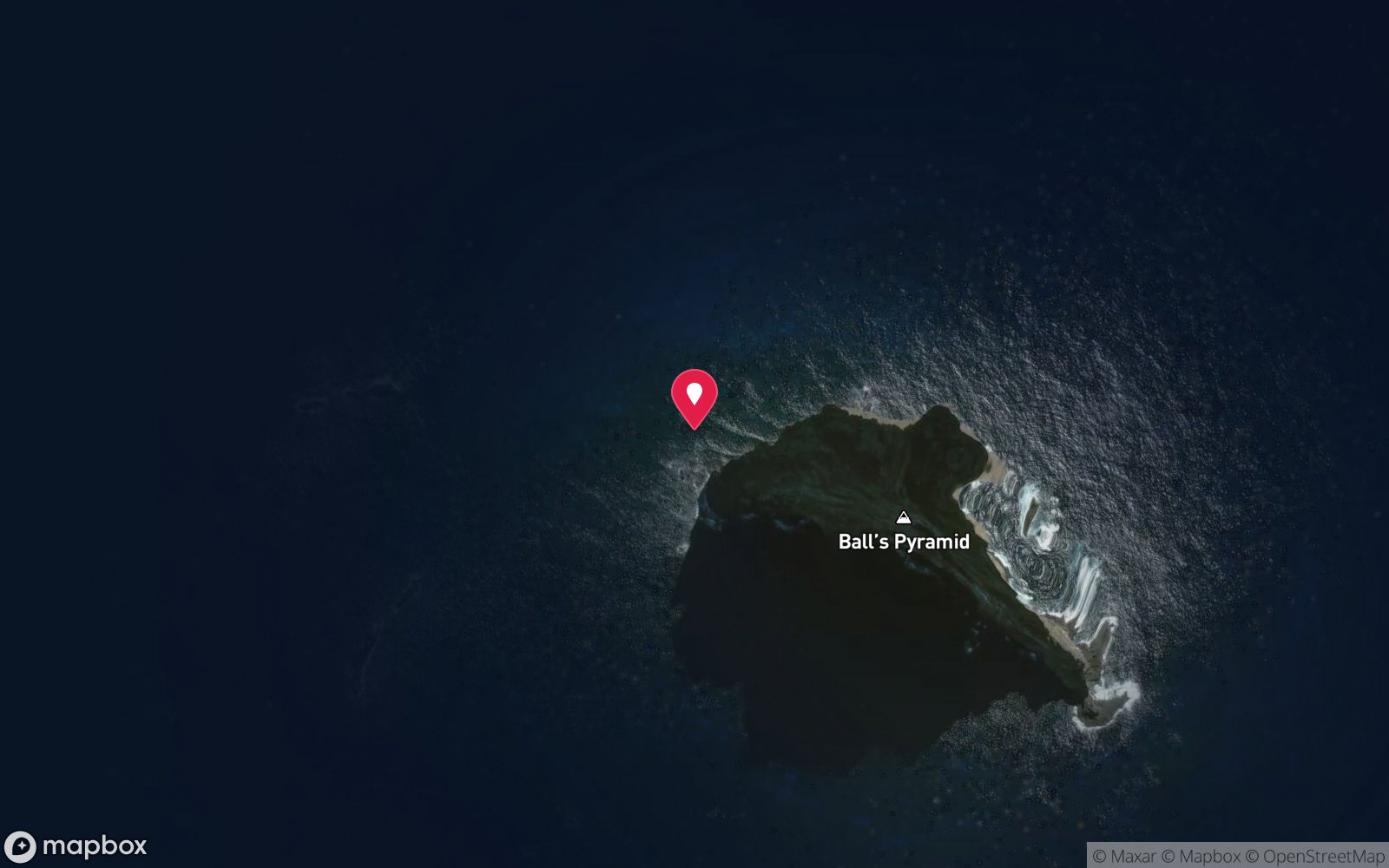
A cluster of submerged rock stacks and gutters off the north-western corner of Balls Pyramid, the 552 m sea stack 23 km south-east of Lord Howe Island.
Lord Howe is reached only by air: QantasLink flies from Sydney daily (about 1 h 50 min), with Brisbane and seasonal Port Macquarie services. Accommodation must be booked before flights (visitor numbers are capped at about 400) and the checked-baggage limit is 14 kg, so most divers hire gear on the island. Dive Lord Howe's shop is at 2 Lagoon Road beside the Lagoon Beach boatsheds; most lodges transfer divers or it is a short bike ride.
Divers board the boat, which is moored in the lagoon, and run out of the lagoon through North Passage or Erscott's Passage, then south past Mt Gower and across 23 km of open ocean to Balls Pyramid – about 45–50 minutes each way in good conditions. Trips cannot be pre-booked: register interest when you book other dives and the shop offers seats when weather and numbers line up (package holders get priority). Allow a week on the island to give yourself a realistic chance.
Entry: Live-boat drop (giant stride or backward roll) onto the site; free or shot-line descent; SMB and free ascent
Facilities: Departure from the Lagoon Road boatsheds; toilets and rinse at the shop.
Weather, swell & tides
The run to Balls Pyramid crosses unprotected ocean, so the trip goes only on the calmest days – operators and published trip reports put the limit at winds under about 10 knots and swell under 2 m. South-east trades above 15 knots, any sizeable southerly or easterly groundswell, or a winter westerly front cancel it. Currents around the Pyramid are unpredictable and can switch direction during a dive, which is why it is run as a live-boat drift.
Late summer and autumn (February–May) give the most flat days; winter trips are rare. There are no stingers and cyclones are very rare, but ex-tropical lows can bring big swell in summer–autumn.
Best season: September–June (the dive shop's main season); February–May for the warmest water and most settled seas
How the dive is usually run
The boat drops divers up-current of the stacks on the sheltered northern side. Descend to 18–25 m among the 5–8 m high rock stacks and zigzag down-current through the gaps, using the rocks as shelter when the current picks up. Look into the caves and the boulder gutter for painted and slipper lobsters.
Work shallower as air allows and finish with a safety stop in open water under an SMB – this is where the Galapagos sharks usually gather.
Marine life
- Galapagos sharks (often dozens)
- Ballina angelfish
- painted rock lobsters
- slipper lobsters
- kingfish
- silver trevally
- rainbow runners
- amberjack
- silver drummer
- black cod
- striped boarfish
- sweetlips
- painted morwong
- half-banded angelfish
- soldierfish
- bull rays
- black coral trees
- sea whips
Linked species have their own page listing every site where they are recorded. All marine life →
Training required
Beyond 18 m an Advanced certification (which includes a deep dive to 30 m) is the accepted minimum. Anything past 25 m is a deep dive in practice.
At more than 25 m this counts as a deep dive: watch no-decompression limits and gas.
Courses that help here
- Enriched Air Nitrox – Longer no-decompression time at 25 m and deeper.
- Cavern Diver – An overhead environment.
- Drift Diver – Current is a feature of the dive.
Depth tiers: 0–10 m easy · to 18 m Open Water · 18–30 m Advanced (25 m+ is a deep dive) · 30–40 m Deep specialty · 40 m+ technical. All courses
Hazards & warnings
Remote site 23 km from the island and roughly 50 minutes from any help; unpredictable and sometimes strong currents; free ascents in open water – carry an SMB and ideally a PLB or dive alert device; large numbers of Galapagos sharks are usually indifferent but can be inquisitive near the surface; seasickness on the crossing; no chamber on Lord Howe.
Technical notes
Nitrox extends bottom time on the 20–30 m sections; confirm availability with the shop. Walls drop well past recreational limits – watch depth.
Dive centres that go here
Dive Lord Howe – Balls Pyramid double-dive charters offered only when weather and diver numbers allow (cannot be scheduled in advance); snorkellers carried if space permits; private charters available. Howea Divers also advertises Balls Pyramid dives.
Operators recorded for Balls Pyramid – Observatory Rock
Dive Lord Howe
ProfiledLord Howe Island · Lord Howe Island · NSW
Lord Howe Island's major verified PADI operation, identified as a PADI 5 Star Dive Resort and running the island's certified diving, training and charters.
divelordhowe.com · (02) 6563 2253
Howea Divers
Named by sitesLord Howe Island · Lord Howe Island · NSW
Phone from lordhoweisland.info listing; own site contact page not extractable.
howeadivers.com.au · (02) 6563 2114
Other dive centres in Lord Howe Island
Islander Cruises
Named by sitesLord Howe Island · Lord Howe Island · NSW
Cruise/snorkel boat operator, also PADI-listed.
islandercruises.com.au · (02) 6563 2298
Marine Adventures
Named by sitesLord Howe Island · Lord Howe Island · NSW
Turtle/snorkel and glass-bottom boat tours, not scuba.
marineadventureslordhowe.com · 0476 513 202
Lord Howe Environmental Tours
Named by sitesLord Howe Island · Lord Howe Island · NSW
Glass-bottom boat and snorkel tours, not scuba.
lordhoweislandtours.com · (02) 6563 2260
Map
7 pinned sites. Pins marked approximate on their pages show the general area only; not for navigation.
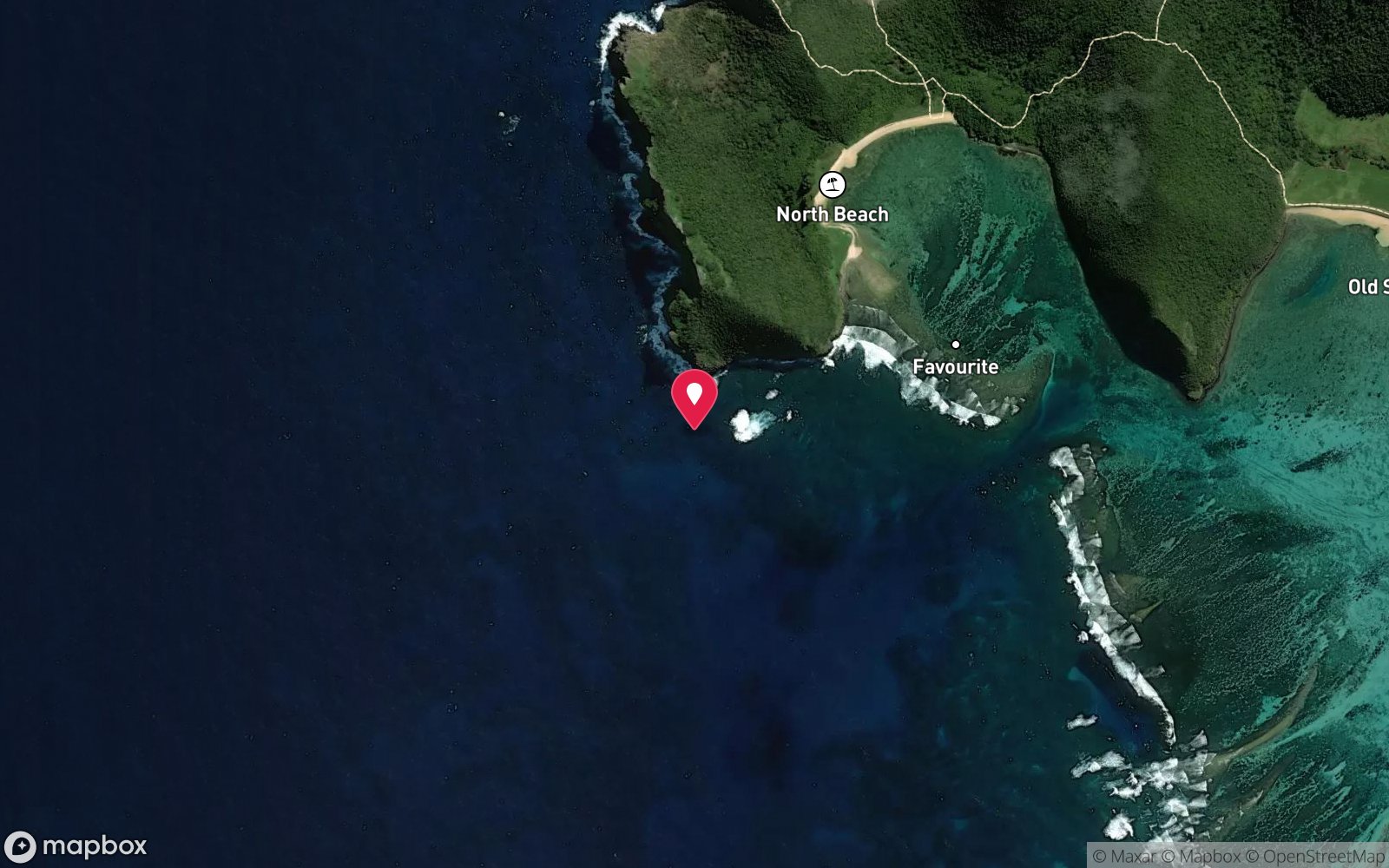
Satellite views
Balls Pyramid – Observatory Rock: frequently asked questions
How deep is Balls Pyramid – Observatory Rock?
Balls Pyramid – Observatory Rock reaches a maximum depth of 28 m, with the shallowest part at about 5 m; most of the dive is spent around 18 m.
What certification do I need to dive Balls Pyramid – Observatory Rock?
Advanced Open Water is the recommended minimum. At more than 25 m this counts as a deep dive: watch no-decompression limits and gas. Rated advanced because of depth beyond 18 m, tidal current that must be timed.
Can I shore dive Balls Pyramid – Observatory Rock?
No, it is reached by boat (about 50 minutes). A dive centre is required: boat access only.
When is the best time to dive Balls Pyramid – Observatory Rock?
September–June (the dive shop's main season); February–May for the warmest water and most settled seas.
What marine life will I see at Balls Pyramid – Observatory Rock?
Regularly recorded: Galapagos sharks (often dozens), Ballina angelfish, painted rock lobsters, slipper lobsters, kingfish, silver trevally, rainbow runners, amberjack, silver drummer, black cod, striped boarfish, sweetlips and more.
What wetsuit do I need at Balls Pyramid – Observatory Rock?
5 mm full suit in summer–autumn; 5–7 mm with hood or a semi-dry from June to October.
How cold is the water at Balls Pyramid – Observatory Rock?
Typically 23-26 °C in summer and 17-20 °C in winter.
What are the main hazards at Balls Pyramid – Observatory Rock?
Remote site 23 km from the island and roughly 50 minutes from any help; unpredictable and sometimes strong currents; free ascents in open water – carry an SMB and ideally a PLB or dive alert device; large numbers of Galapagos sharks are usually indifferent but can be inquisitive near the surface; seasickness on the crossing; no chamber on Lord Howe. See the hazards section above for the full list.
Where is the nearest recompression chamber to Balls Pyramid – Observatory Rock?
Prince of Wales Hospital (Randwick, Sydney) – about 780 km; no chamber on Lord Howe, evacuation by air ambulance via Gower Wilson Memorial Hospital and the island airstrip. In an emergency call 000, then DAN Asia-Pacific on 1800 088 200.
Diving in Lord Howe Island
Lord Howe is the world's southernmost coral reef, a World Heritage island 600 km east of the mainland with more than 90 coral species, 500 fish species and a mix of tropical and temperate life found nowhere else. The lagoon is shallow and snorkel-friendly; the outer sites, the Admiralty Islets, Erscott's Hole and the Arch, are boat dives in 20–40 m visibility with Galapagos whalers, huge kingfish and endemic doubleheader wrasse. Ball's Pyramid, 23 km south, is a rare-weather expedition dive.
Getting there: Fly from Sydney, Brisbane or Port Macquarie. One dive operator on the island runs boat dives most days in season; visitor numbers are capped at 400, so book early.
Sources
- diveplanit.com/dive-sites/australia/lord-howe-island/balls-pyramid
- diveplanit.com/dive-destination/lord-howe-island-an-experience-worth-the-cost
- prodive.com.au/locations/Scubadive/lord+howe+island/view/Dive_Site
- divelordhowe.com/balls-pyramid
- michaelmcfadyenscuba.info/viewpage.php?page_id=1023
Data confidence: High · Being verified: Coordinates approximate. Wheatsheaf Islet was a v1 alt name; no separately documented dive site of that name found.. Last updated September 2026. Know this site better? How to send a correction