Dive slate · divesites.com.au · printed 9 Nov 2026
Comet's Hole
Lord Howe Island, New South Wales · near Lord Howe Island (Lagoon Road boatsheds)
| Depth | 1–7 m |
|---|---|
| Minimum level | Snorkel/Any |
| Difficulty | Beginner |
| Access | Boat (day trip) |
| Entry | Backward roll or giant stride from the dive or snorkel boat |
| Current | Mild |
| Visibility | 10-20 m |
| Water | summer 23-26 °C, winter 17-20 °C |
| Suit | 5 mm full suit in summer–autumn; 5–7 mm with hood or a semi-dry from June to October |
| Best season | September–June (the dive shop's main season); February–May for the warmest water and most settled seas |
| Bottom time | 60 min |
| Position | -31.53500, 159.06200 (approximate) |
| Permit | Lord Howe Island Marine Park – lagoon sanctuary zone: no fishing or collecting; no anchoring in sanctuary zones (use moorings); vessels over 5 m may not anchor anywhere in the lagoon |
| Nearest chamber | Prince of Wales Hospital (Randwick, Sydney) – about 780 km; no chamber on Lord Howe, evacuation by air ambulance via Gower Wilson Memorial Hospital and the island airstrip |
| Emergency | 000 · DAN Asia-Pacific diving emergency 1800 088 200 |
Comet's Hole
Also known as Comets Hole
The easiest introduction to Lord Howe's fish – a coral-walled lagoon hole packed with endemics.
Near Lord Howe Island (Lagoon Road boatsheds) · Lord Howe Island, New South Wales
- Depth
- 1–7 m
- Minimum level
- Snorkel/Any
- Access
- Boat (day trip)
- Boat ride
- ~5 min
- Water
- 23-26 °C
- Visibility
- 10-20 m
Comet's Hole1–7 m · Snorkel/Any
Dive factsDepths, conditions, location & safety
Season
In season nowBest months: January, February, March, April, May, June, September, October, November, December.
September–June (the dive shop's main season); February–May for the warmest water and most settled seas
- Best months
- Now (November)
- Stinger suit Nov–May
Dive facts
- Depth
- 1–7 m
- Typical depth
- 3 m
- Certification
- Snorkel/Any
- Difficulty
- Beginner
- Depth tier
- Easy (0–10 m)
- Access
- Boat (day trip)
- Offshore
- 1 km
- Dive centre needed
- Recommended
- Shore / independent
- No
- Boat ride
- ~5 min
- Current
- Mild
- Visibility
- 10-20 m
- Water temp (summer)
- 23-26 °C
- Water temp (winter)
- 17-20 °C
- Water
- Subtropical
- Bottom time
- 60 min
- Dive traffic
- Very popular (dived daily)
- Night dive
- Possible
- Snorkel friendly
- Yes
Exposure suit
5 mm full suit in summer–autumn; 5–7 mm with hood or a semi-dry from June to October
Location
Lagoon – southern sanctuary
-31.53500, 159.06200
Approximate position — not for navigation.
Open in Google MapsPrimary source: diveplanit.comMarine park & permits
Lord Howe Island Marine Park – lagoon sanctuary zone: no fishing or collecting; no anchoring in sanctuary zones (use moorings); vessels over 5 m may not anchor anywhere in the lagoon
Nearest recompression chamber
Prince of Wales Hospital (Randwick, Sydney) – about 780 km; no chamber on Lord Howe, evacuation by air ambulance via Gower Wilson Memorial Hospital and the island airstrip
Diving emergency: call 000, then DAN AP 1800 088 200.
Trip planner
Build a trip around Comet's Hole →
A day-by-day plan for Lord Howe Island with this site locked in.
This guide is a planning aid. Conditions change daily — confirm with a local dive centre and dive within your training. Data & safety notes.
Dive profile
How this site rates
Scores are computed from the recorded data, not opinions. How?
At a glance
Comet's Hole is a reef boat dive in Lord Howe Island, NSW, 1–7 m, suitable for snorkellers and first-time divers, about 5 minutes by boat.
Rated beginner: sheltered, shallow and manageable for a newly certified diver on a normal day, though note boat traffic overhead.
Why dive here
- The easiest introduction to Lord Howe's fish – a coral-walled lagoon hole packed with endemics.
- Snorkel-friendly, so non-diving companions can join at the surface.
- Visibility often reaches 10-20 m.
About Comet's Hole
Comet's Hole is the Lord Howe lagoon site most often used to introduce divers and snorkellers to the island's marine life. Diveplanit places it well within the sheltered lagoon, just minutes from the boatshed, and describes a 3–4 m high coral reef wall around a hole with a median depth of 3 m and a maximum of 7 m. Divernet puts it at 7–8 m, and the DAN account describes it with Erscott's Hole as a circular pool with coral walls.
The variety of fish is what makes it. Diveplanit's list includes swarms of catfish, Lord Howe butterflyfish, doubleheader wrasse, Lord Howe moray, zebra morwong, McCulloch's anemonefish, black stingrays, kingfish, drummer, sweetlips, stripeys, footballers, peacock flounder, angelfish and Galapagos sharks. Divernet adds lined catfish, decorator crabs, three types of lionfish and marble shrimp, with Porites, Acropora and needle corals on the walls. The island pocket guide adds three-striped butterflyfish.
Diveplanit calls it 'one of the easiest dives around' and 'the best possible introduction to the diversity of marine life around Lord Howe Island', and because it is inside the lagoon it is diveable when other sites are not. It suits beginners, courses and snorkellers.
Note that Michael McFadyen's page titled 'Comets Hole' gives the same GPS position and description as his page for The Arch, a 6–30 m coral arch on the outer reef. The lagoon site described here is the one operators and the tourism body mean by Comet's Hole, so The Arch is listed separately. Snorkel boats and the dive shop both visit, so it can be busy mid-morning.
Getting there & entry
A coral-walled pool about 7 m deep well inside the sheltered lagoon, minutes from the boatsheds.
Lord Howe is reached only by air: QantasLink flies from Sydney daily (about 1 h 50 min), with Brisbane and seasonal Port Macquarie services. Accommodation must be booked before flights (visitor numbers are capped at about 400) and the checked-baggage limit is 14 kg, so most divers hire gear on the island. The lagoon sites are reached from the Lagoon Road boatsheds: Dive Lord Howe's boat is moored in the lagoon and reaches the holes in about 5 minutes, and glass-bottom and snorkel boats (Islander Cruises, Marine Adventures, Lord Howe Environmental Tours and others) run daily trips.
Snorkellers can also hire kayaks at the boatsheds, but the holes are well offshore near the barrier reef, so a guided boat is the practical option.
Entry: Backward roll or giant stride from the dive or snorkel boat
Facilities: Boatsheds on Lagoon Road with gear, kayak and SUP hire; toilets and cafes near Lagoon Beach.
Weather, swell & tides
The lagoon is protected by the fringing barrier reef on the island's western side and is diveable in almost all weather, which is why operators use it when the outer reef is closed. Strong westerly and south-westerly winds – mainly with winter fronts – make it choppy and push swell over the reef, stirring the sand and cutting visibility. The holes are deep enough to dive at any tide, but the surrounding lagoon floor is very shallow at low tide and boats time runs accordingly.
Visibility is usually around 10–20 m (lower than outside the reef), and water is warmest from January to April.
Best season: September–June (the dive shop's main season); February–May for the warmest water and most settled seas
If it's blown out
Sheltered or shore sites within 25 km that often work when Comet's Hole doesn't.
- Blackburn Island · 1 km · Depth not published
- Erscott's Hole · 1 km · Max 8 m
- Sylph's Hole · 2 km · Max 5 m
- Old Settlement Beach · 2 km · Max 4 m
How the dive is usually run
Divers descend to the sand at 5–7 m and follow the 3–4 m high coral wall around the hole, looking at the anemones for McCulloch's anemonefish and on the sand for rays and peacock flounder. Snorkellers float over the rim.
Marine life
- McCulloch's anemonefish
- Lord Howe butterflyfish
- three-striped butterflyfish
- doubleheader wrasse
- Lord Howe moray
- zebra morwong
- catfish swarms
- black stingrays
- kingfish
- drummer
- sweetlips
- peacock flounder
- lionfish
- decorator crabs
- marble shrimp
- Galapagos sharks
- Porites and Acropora corals
Linked species have their own page listing every site where they are recorded. All marine life →
Training required
Shallow enough for snorkellers and for a first dive under supervision. Any certified diver can dive it.
Depth tiers: 0–10 m easy · to 18 m Open Water · 18–30 m Advanced (25 m+ is a deep dive) · 30–40 m Deep specialty · 40 m+ technical. All courses
Hazards & warnings
Boat traffic from snorkel and glass-bottom boats; wind chop and current near the reef passages on a falling tide; do not stand on or touch coral; no chamber on Lord Howe.
Dive centres that go here
Dive Lord Howe – lagoon dives used daily as a sheltered option and for courses; snorkel and glass-bottom boat tours by Islander Cruises (daily access to the southern and northern sanctuaries), Marine Adventures, Lord Howe Environmental Tours, Reef N Beyond and Liv For The Sea.
Operators recorded for Comet's Hole
Dive Lord Howe
ProfiledLord Howe Island · Lord Howe Island · NSW
Lord Howe Island's major verified PADI operation, identified as a PADI 5 Star Dive Resort and running the island's certified diving, training and charters.
divelordhowe.com · (02) 6563 2253
Islander Cruises
Named by sitesLord Howe Island · Lord Howe Island · NSW
Cruise/snorkel boat operator, also PADI-listed.
islandercruises.com.au · (02) 6563 2298
Marine Adventures
Named by sitesLord Howe Island · Lord Howe Island · NSW
Turtle/snorkel and glass-bottom boat tours, not scuba.
marineadventureslordhowe.com · 0476 513 202
Lord Howe Environmental Tours
Named by sitesLord Howe Island · Lord Howe Island · NSW
Glass-bottom boat and snorkel tours, not scuba.
lordhoweislandtours.com · (02) 6563 2260
Other dive centres in Lord Howe Island
Map
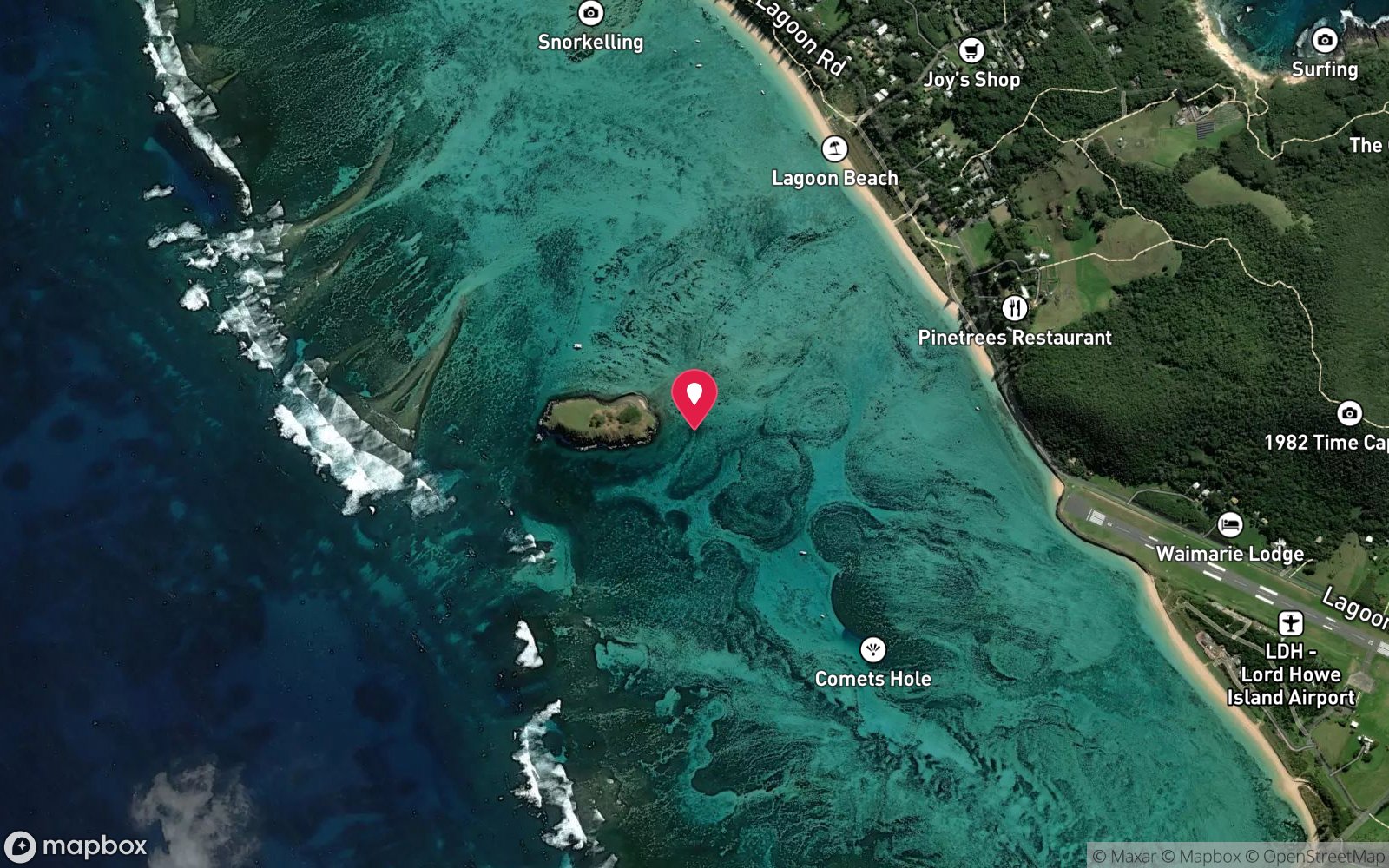
7 pinned sites. Pins marked approximate on their pages show the general area only; not for navigation.
Satellite views
Comet's Hole: frequently asked questions
How deep is Comet's Hole?
Comet's Hole reaches a maximum depth of 7 m, with the shallowest part at about 1 m; most of the dive is spent around 3 m.
What certification do I need to dive Comet's Hole?
No certification is needed to snorkel it, and it suits introductory dives. Rated beginner: sheltered, shallow and manageable for a newly certified diver on a normal day, though note boat traffic overhead.
Can I shore dive Comet's Hole?
No, it is reached by boat (about 5 minutes).
When is the best time to dive Comet's Hole?
September–June (the dive shop's main season); February–May for the warmest water and most settled seas.
What marine life will I see at Comet's Hole?
Regularly recorded: McCulloch's anemonefish, Lord Howe butterflyfish, three-striped butterflyfish, doubleheader wrasse, Lord Howe moray, zebra morwong, catfish swarms, black stingrays, kingfish, drummer, sweetlips, peacock flounder and more.
What wetsuit do I need at Comet's Hole?
5 mm full suit in summer–autumn; 5–7 mm with hood or a semi-dry from June to October.
How cold is the water at Comet's Hole?
Typically 23-26 °C in summer and 17-20 °C in winter.
What are the main hazards at Comet's Hole?
Boat traffic from snorkel and glass-bottom boats; wind chop and current near the reef passages on a falling tide; do not stand on or touch coral; no chamber on Lord Howe. See the hazards section above for the full list.
Where is the nearest recompression chamber to Comet's Hole?
Prince of Wales Hospital (Randwick, Sydney) – about 780 km; no chamber on Lord Howe, evacuation by air ambulance via Gower Wilson Memorial Hospital and the island airstrip. In an emergency call 000, then DAN Asia-Pacific on 1800 088 200.
Diving in Lord Howe Island
Lord Howe is the world's southernmost coral reef, a World Heritage island 600 km east of the mainland with more than 90 coral species, 500 fish species and a mix of tropical and temperate life found nowhere else. The lagoon is shallow and snorkel-friendly; the outer sites, the Admiralty Islets, Erscott's Hole and the Arch, are boat dives in 20–40 m visibility with Galapagos whalers, huge kingfish and endemic doubleheader wrasse. Ball's Pyramid, 23 km south, is a rare-weather expedition dive.
Getting there: Fly from Sydney, Brisbane or Port Macquarie. One dive operator on the island runs boat dives most days in season; visitor numbers are capped at 400, so book early.
Sources
- diveplanit.com/dive-sites/australia/lord-howe-island/comets-hole
- divernet.com/world-dives/lord-howe-island-australias-hidden-gem-of-natural-beauty
- daninsider.org/2017/08/17/lord-howe-island
- lordhoweisland.info/wp-content/uploads/2023/03/LHI-Pocket-Guide-V3.pdf
- lordhoweisland.info/experiences/snorkelling-and-diving/diving
- islandercruises.com.au/tours.html
- michaelmcfadyenscuba.info/viewpage.php?page_id=1022
Data confidence: High · Being verified: McFadyen's 'Comets Hole' page appears to describe The Arch (same GPS).. Last updated September 2026. Know this site better? How to send a correction
Nearby dive sites
More reef dives in New South Wales
Explore more