Dive slate · divesites.com.au · printed 9 Nov 2026
Ex-HMAS Brisbane
Sunshine Coast, Queensland · near Mooloolaba
| Depth | 3–28 m |
|---|---|
| Minimum level | Advanced Open Water |
| Difficulty | Intermediate |
| Access | Boat (day trip) |
| Entry | Giant stride from a licensed operator's boat on a conservation-park mooring; descend the mooring line to the superstructure |
| Current | Mild |
| Visibility | 12-20 m |
| Water | summer 25-27 °C, winter 19-21 °C |
| Suit | 3 mm full suit in summer; 5-7 mm full suit and hood June-September |
| Best season | Year-round; winter for visibility, grey nurse sharks and humpback whales; summer for leopard sharks |
| Bottom time | 45 min |
| Position | -26.66500, 153.14830 (approximate) |
| Permit | Ex-HMAS Brisbane Conservation Park (Nature Conservation Act 1992 restricted access area) – QPWS permit required for every diver and snorkeller. Via licensed operators, or private permits in 3-hour timeslots (private divers about $54 each, club divers $48, max 4 per private and 10 per club booking). |
| Nearest chamber | Royal Brisbane & Women's Hospital hyperbaric unit (Herston, Brisbane) — nearest chamber; Wesley Hospital hyperbaric unit (Auchenflower, Brisbane) is the alternative. Divers Emergency Service 1800 088 200. |
| Emergency | 000 · DAN Asia-Pacific diving emergency 1800 088 200 |
Ex-HMAS Brisbane
Also known as HMAS Brisbane wreck, DDG-41, Ex-HMAS Brisbane Conservation Park
Queensland's great destroyer wreck – 133 m, upright, funnels 3 m below the surface and 1000+ species – now with a cyclone-displaced forward superstructure forming a new fish-filled gutter; currently external dives only.
Near Mooloolaba · Sunshine Coast, Queensland
- Depth
- 3–28 m
- Minimum level
- Advanced Open Water
- Access
- Boat (day trip)
- Boat ride
- ~20 min
- Water
- 25-27 °C
- Visibility
- 12-20 m
Ex-HMAS Brisbane3–28 m · Advanced Open Water
Dive factsDepths, conditions, location & safety
Season
In season nowBest months: year-round.
Year-round; winter for visibility, grey nurse sharks and humpback whales; summer for leopard sharks
- Best months
- Now (November)
- Stinger suit Nov–May
Dive facts
- Depth
- 3–28 m
- Typical depth
- 18 m
- Certification
- Advanced Open Water
- Difficulty
- Intermediate
- Depth tier
- Advanced Open Water (18–30 m)
- Access
- Boat (day trip)
- Offshore
- 5.4 km
- Dive centre needed
- Yes – permit/guide required
- Shore / independent
- No
- Boat ride
- ~20 min
- Current
- Mild
- Visibility
- 12-20 m
- Water temp (summer)
- 25-27 °C
- Water temp (winter)
- 19-21 °C
- Water
- Subtropical
- Bottom time
- 45 min
- Dive traffic
- Very popular (dived daily)
- Night dive
- Possible
- Snorkel friendly
- No
Exposure suit
3 mm full suit in summer; 5-7 mm full suit and hood June-September
Location
Ex-HMAS Brisbane Conservation Park · Sunshine Coast – Mooloolaba
-26.66500, 153.14830
Approximate position — not for navigation.
Open in Google MapsDive site map (external) →Primary source: parks.qld.gov.auTags
Marine park & permits
Ex-HMAS Brisbane Conservation Park (Nature Conservation Act 1992 restricted access area) – QPWS permit required for every diver and snorkeller. Via licensed operators, or private permits in 3-hour timeslots (private divers about $54 each, club divers $48, max 4 per private and 10 per club booking).
Nearest recompression chamber
Royal Brisbane & Women's Hospital hyperbaric unit (Herston, Brisbane) — nearest chamber; Wesley Hospital hyperbaric unit (Auchenflower, Brisbane) is the alternative. Divers Emergency Service 1800 088 200.
Diving emergency: call 000, then DAN AP 1800 088 200.
Trip planner
Build a trip around Ex-HMAS Brisbane →
A day-by-day plan for Sunshine Coast with this site locked in.
This guide is a planning aid. Conditions change daily — confirm with a local dive centre and dive within your training. Data & safety notes.
Dive profile
How this site rates
Scores are computed from the recorded data, not opinions. How?
At a glance
Ex-HMAS Brisbane is a wreck boat dive in Sunshine Coast, QLD, 3–28 m, suited to Advanced Open Water divers, about 20 minutes by boat.
Rated intermediate because of depth beyond 18 m, surge on the entry or in the shallows, boat traffic overhead, wreck penetration options that need training.
Why dive here
- Queensland's great destroyer wreck – 133 m, upright, funnels 3 m below the surface and 1000+ species – now with a cyclone-displaced forward superstructure forming a new fish-filled gutter; currently external dives only.
- Sunk in 2005.
- Visibility often reaches 12-20 m.
Conditions to avoid
- Wind over about 20 knots
- Strong southerly or south-east swell and wind
- Strong northerlies
- Cyclone season (roughly December–April)
About Ex-HMAS Brisbane
The ex-HMAS Brisbane is one of Australia's best-known wreck dives. Commissioned in 1967, the Charles F. Adams-class guided-missile destroyer served the Royal Australian Navy for 34 years, including in the Vietnam War and the 1991 Gulf War. After decommissioning she was prepared as a dive site – with around 30 access holes cut through her hull and decks and three points of natural light inside – and scuttled on 31 July 2005 about 2.9 nm east of Mudjimba Island. She sank in 2 minutes 10 seconds and landed upright on sand in 27-28 m.
The layout is classic warship. The forward decks lie at about 15 m and the stern at 18 m, with the bridge, masts and funnels rising towards the surface – the top of the funnel is only about 3 m down. QPWS describes a ship eight storeys tall and 133 m long, with the forward engine room, boiler room, gun mount and crew quarters prepared for penetration. The wreck is protected within the Ex-HMAS Brisbane Conservation Park, managed by Queensland Parks and Wildlife Service.
In March 2025 ex-Tropical Cyclone Alfred reshaped her. A whole section below the forward funnel detached and now rests upright on the sand beside the port side, creating a gutter that Divernet describes as an instant fish sanctuary. The site was closed while rangers secured the loose structure; operators have since resumed guided dives on an external-only basis, pending a full internal inspection before penetration is allowed again. QPWS currently lists the public mooring and public access as closed (30 June 2026 to 31 January 2027), so check status before planning a private visit.
More than 1000 marine species and over 350 fish species have been recorded. Divers see kingfish schools, Queensland gropers, bull and eagle rays, wedgefish, turtles, lionfish, anglerfish, octopus, nudibranchs, leopard sharks in summer and grey nurse sharks in winter, with humpback whales passing overhead. The external dive suits Open Water divers; the deeper hull suits Advanced divers.
The ship and the sinking
HMAS Brisbane (D 41) was a Charles F. Adams-class guided-missile destroyer built by Defoe Shipbuilding in Bay City, Michigan, one of three the Royal Australian Navy bought from the United States in the 1960s. Commissioned in December 1967, she was 133 m long and 4,500 tons full load, armed with two 5-inch guns and a Tartar missile launcher.
She served two tours off Vietnam in 1969 and 1971 on the gun line, firing thousands of rounds in shore bombardment, and in 1991 sailed with the Australian task group to the Gulf War, one of the last ships in the world of her class still in service. She was decommissioned in October 2001 after 34 years.
The Queensland Government acquired her as a dive site. Over two years she was stripped of fuel, wiring, insulation and hazards, and around thirty access holes were cut through her hull and decks so that divers could move through her with natural light. On 31 July 2005 she was scuttled 2.9 nautical miles east of Mudjimba Island in front of a flotilla of spectators; she sank in a little over two minutes and settled upright on sand in 27–28 m.
What is there today
Her decks lie at 15–18 m and the funnels reach to within a few metres of the surface, so the wreck suits Open Water divers on the superstructure and Advanced divers through the bridge, operations room and engine room. More than a thousand species have been recorded on her. Cyclone Seth in 2022 displaced the forward gun mount, which now lies beside the hull. She sits in a marine park with a permit system that funds the moorings.
Wrecks older than 75 years, and several younger ones, are protected under the Underwater Cultural Heritage Act 2018: look, photograph, take nothing. Australia's oldest wreck dives →
Wreck details
Charles F. Adams-class guided-missile destroyer (DDG-41), 133 m, ~5000 t; commissioned 1967, scuttled 31 July 2005 · Sunk 2005
Era: modern, mostly scuttled as artificial reefs. Oldest wrecks · Wartime wrecks · Scuttled warships
Other wrecks of the same era
- Shannon II Wreck · Depth not published · Bundaberg & Agnes Water
- Karma Wreck · Max 27 m · Bundaberg & Agnes Water
- Light Ships (Cochrane Artificial Reef) · Max 18 m · Bundaberg & Agnes Water
- Harry Atkinson Artificial Reef · Max 21 m · Brisbane & Moreton Bay
- The Barge (Cochrane Artificial Reef) · Max 15 m · Bundaberg & Agnes Water
- Severance Wreck (Lady Elliot Island) · Max 21 m · Lady Elliot Island
Getting there & entry
133 m Charles F. Adams-class guided-missile destroyer scuttled upright on sand in 27-28 m on 31 July 2005, about 2.8-2.9 nm east of Mudjimba Island off Mooloolaba; a restricted-access conservation park. Forward superstructure displaced by ex-Tropical Cyclone Alfred in March 2025.
Mooloolaba's dive boats leave from The Wharf on the Mooloolah River (Parkyn Parade, Mooloolaba), about 1.5 hours' drive north of Brisbane via the Bruce Highway and Sunshine Motorway. Scuba World's shop is about 40 m from its boat, with 100+ free all-day parking spaces nearby; Sunreef departs from the same precinct. Boats run down the calm river, cross the Mooloolah River mouth beside Point Cartwright and head north-east to the reefs – about 15 minutes to the Inner Gneerings and Mudjimba Island.
Private boats can launch at the Mooloolaba (Parkyn Parade/Lions Park) ramps. The wreck lies about 2.9 nm east of Mudjimba Island: Sunreef quotes about 15 minutes from the river mouth and Scuba World about 30 minutes from its shop. Entry to the conservation park requires a QPWS permit: dive with a licensed operator (Scuba World or Sunreef), or book a private-diver or club permit in 3-hour timeslots.
Boats must use the conservation-park moorings – anchoring is not permitted. Note that QPWS lists the public mooring as closed and public access closed from 30 June 2026 to 31 January 2027 following cyclone damage; confirm current access with an operator.
Entry: Giant stride from a licensed operator's boat on a conservation-park mooring; descend the mooring line to the superstructure
Facilities: Departure: The Wharf, Mooloolaba (Scuba World and Sunreef shops, free all-day parking, cafes, toilets)
Weather, swell & tides
The Mooloolaba reefs are open-ocean sites with no shelter from the south-east trade winds or easterly swell. Operators generally cancel when winds exceed about 20 knots or swell makes the river-mouth crossing and moorings unsafe; they confirm trips by email and text around 3.30 pm the day before. Northerly winds (common on summer afternoons) also make the reefs choppy, so morning trips are more reliable.
Visibility averages about 12 m offshore (range 3-30 m) and is clearest after southerly winds and in winter; it drops after easterly blows and heavy rain. Winter (June-October) brings 19-21°C water, grey nurse sharks and humpback whales; summer (November-May) brings 25-27°C water, leopard sharks and lower visibility. The wreck's superstructure rises to within about 3 m of the surface, so surge is felt on the funnel and bridge in any swell; the decks at 15-18 m are calmer.
Best season: Year-round; winter for visibility, grey nurse sharks and humpback whales; summer for leopard sharks
If it's blown out
Sheltered or shore sites within 25 km that often work when Ex-HMAS Brisbane doesn't.
- La Balsa Park · 3 km · Max 6 m
- Point Cartwright · 2 km · Max 8 m
- Kings Beach (Caloundra) · 15 km · Max 6 m
How the dive is usually run
Current operations are external only. Descend a mooring line to the superstructure, drop to the forward deck at about 15 m and tour the bow and forward gun mount, then look at the displaced forward superstructure now lying upright on the sand off the port side, which has formed a gutter full of fish. Return aft along the upper decks past the funnels to the stern at about 18 m, then come back up the superstructure.
Safety stop on the mooring line or around the funnel tops. Divers qualified to the sand (Advanced) can explore down to the keel at 27-28 m.
Marine life
- Yellowtail kingfish schools
- Queensland groper
- bull rays
- eagle rays
- shovelnose rays
- wedgefish
- hawksbill and loggerhead turtles →
- lionfish
- scorpionfish
- anglerfish
- octopus →
- squid →
- nudibranchs →
- clownfish
- batfish
- sweetlips
- snapper
- red emperor
- leopard sharks (summer) →
- grey nurse sharks (winter) →
- humpback whales (winter) →
Linked species have their own page listing every site where they are recorded. All marine life →
Training required
Beyond 18 m an Advanced certification (which includes a deep dive to 30 m) is the accepted minimum. Anything past 25 m is a deep dive in practice.
Open Water divers can dive the shallower section (typical depth 18 m); the full site to 28 m needs Advanced Open Water. Operators often quote Open Water. At more than 25 m this counts as a deep dive: watch no-decompression limits and gas.
Operators' own listing: Open Water.
Courses that help here
- Enriched Air Nitrox – Longer no-decompression time at 25 m and deeper.
- Wreck Diver – The wreck has penetration options.
Depth tiers: 0–10 m easy · to 18 m Open Water · 18–30 m Advanced (25 m+ is a deep dive) · 30–40 m Deep specialty · 40 m+ technical. All courses
Hazards & warnings
Permit-only conservation park; no anchoring; PENETRATION CURRENTLY PROHIBITED (external dives only) since Cyclone Alfred (March 2025) pending internal inspection; QPWS lists public mooring/public access closed 30 June 2026-31 January 2027; loose or shifted structure around the damaged forward section; surge near the funnels; depth to 28 m at the keel; boat traffic; QPWS 'beware sharks' warning.
Technical notes
QPWS certification guide: upper/outer decks – Open Water; outside to the sand – Advanced Open Water; upper penetration – wreck certification; lower penetration – advanced experience/wreck certification (all penetration suspended at present). Minimum recommended 10 logged open-water dives. Nitrox useful for the 18-28 m sections.
Dive centres that go here
Scuba World Mooloolaba – double-dive half-day trips (guaranteed Saturday and Sunday departures, weather permitting), Open Water minimum with prior boat-dive experience, currently outside only; Sunreef Mooloolaba – double dives, currently external only. Both are the QPWS-licensed operators. Private and club divers need QPWS permits.
Operators recorded for Ex-HMAS Brisbane
Scuba World Mooloolaba
ListedMooloolaba · Sunshine Coast · QLD
A Sunshine Coast business combining training, retail and local boat diving including the ex-HMAS Brisbane.
scubaworld.com.au · (07) 5444 8595
Sunreef Mooloolaba
ListedMooloolaba · Sunshine Coast · QLD
A Mooloolaba operation closely associated with the ex-HMAS Brisbane wreck alongside local reef diving and training.
sunreef.com.au · (07) 5444 5656
SubSurface Scuba
Named by sitesMooloolaba · Sunshine Coast · QLD
subsurfacescuba.com · (07) 5493 9097
Other dive centres in Sunshine Coast
Map
7 pinned sites. Pins marked approximate on their pages show the general area only; not for navigation.
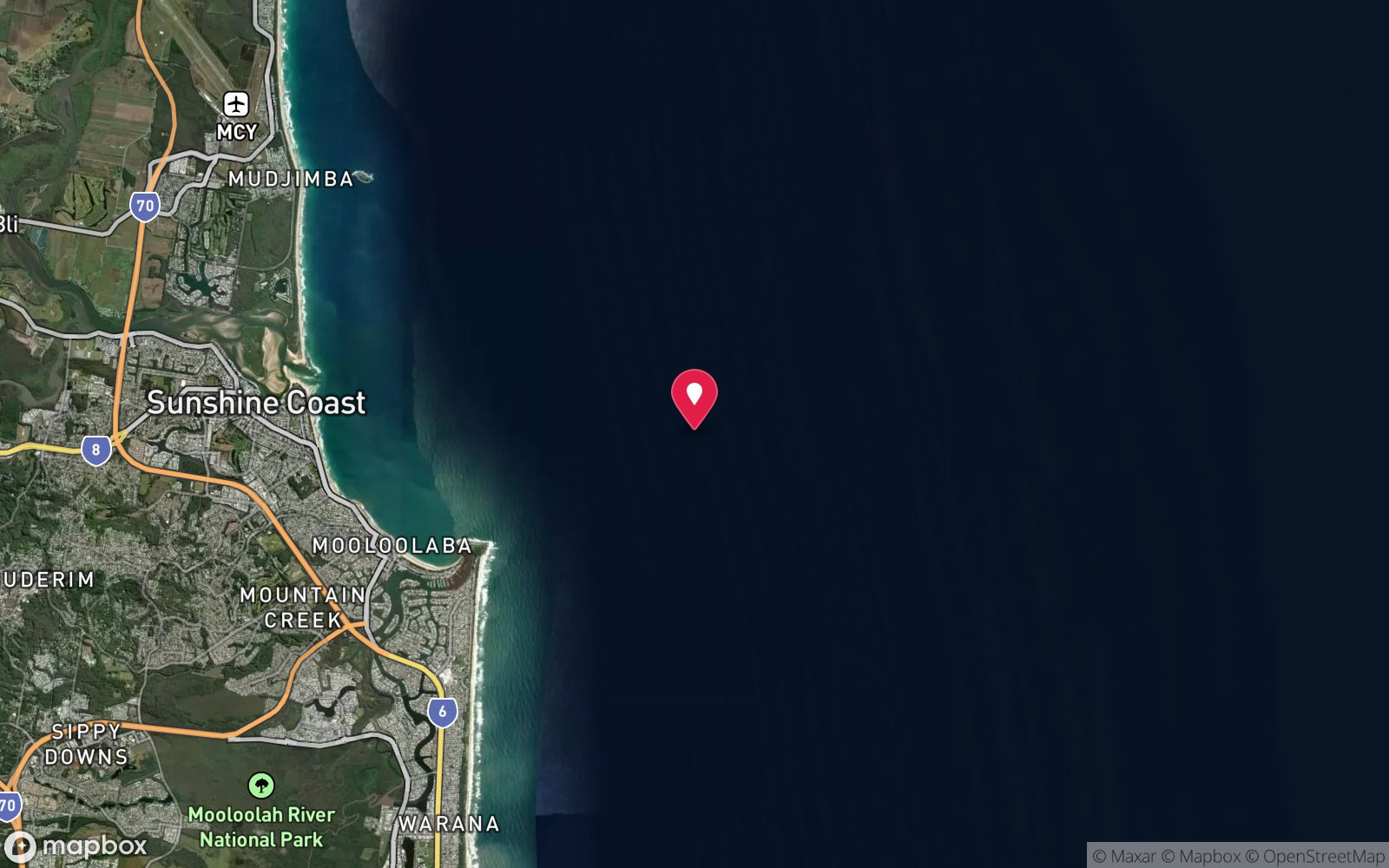
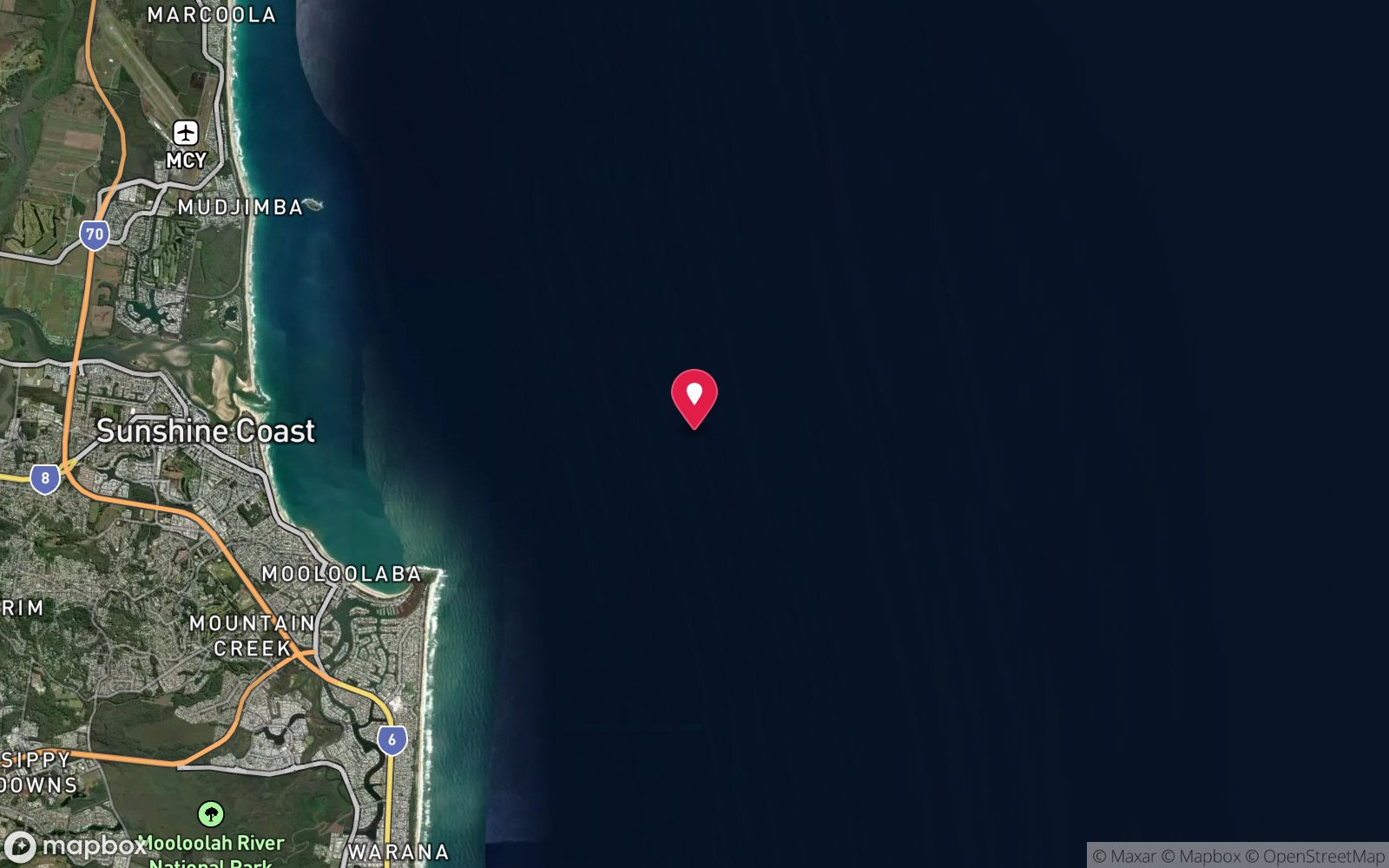
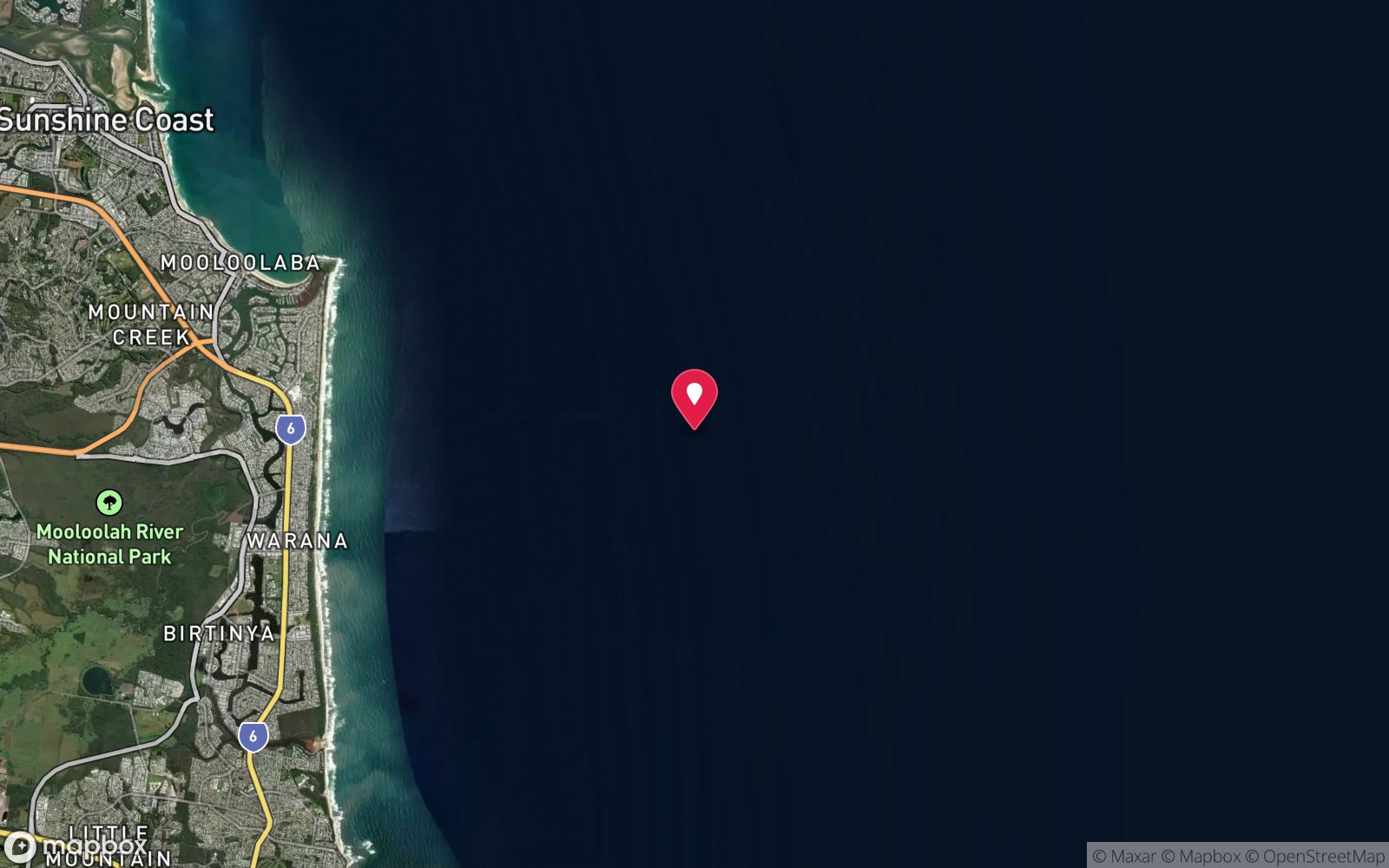
Satellite views
Ex-HMAS Brisbane: frequently asked questions
How deep is Ex-HMAS Brisbane?
Ex-HMAS Brisbane reaches a maximum depth of 28 m, with the shallowest part at about 3 m; most of the dive is spent around 18 m.
What certification do I need to dive Ex-HMAS Brisbane?
Advanced Open Water is the recommended minimum. Open Water divers can dive the shallower section (typical depth 18 m); the full site to 28 m needs Advanced Open Water. Operators often quote Open Water. At more than 25 m this counts as a deep dive: watch no-decompression limits and gas. Rated intermediate because of depth beyond 18 m, surge on the entry or in the shallows, boat traffic overhead, wreck penetration options that need training.
Can I shore dive Ex-HMAS Brisbane?
No, it is reached by boat (about 20 minutes). A dive centre is required: permit/guide required.
When is the best time to dive Ex-HMAS Brisbane?
Year-round; winter for visibility, grey nurse sharks and humpback whales; summer for leopard sharks.
What marine life will I see at Ex-HMAS Brisbane?
Regularly recorded: Yellowtail kingfish schools, Queensland groper, bull rays, eagle rays, shovelnose rays, wedgefish, hawksbill and loggerhead turtles, lionfish, scorpionfish, anglerfish, octopus, squid and more.
What wetsuit do I need at Ex-HMAS Brisbane?
3 mm full suit in summer; 5-7 mm full suit and hood June-September.
How cold is the water at Ex-HMAS Brisbane?
Typically 25-27 °C in summer and 19-21 °C in winter.
What are the main hazards at Ex-HMAS Brisbane?
Permit-only conservation park; no anchoring; PENETRATION CURRENTLY PROHIBITED (external dives only) since Cyclone Alfred (March 2025) pending internal inspection; QPWS lists public mooring/public access closed 30 June 2026-31 January 2027; loose or shifted structure around the damaged forward section; surge near the funnels; depth to 28 m at the keel; boat traffic; QPWS 'beware sharks' warning. See the hazards section above for the full list.
Where is the nearest recompression chamber to Ex-HMAS Brisbane?
Royal Brisbane & Women's Hospital hyperbaric unit (Herston, Brisbane) — nearest chamber; Wesley Hospital hyperbaric unit (Auchenflower, Brisbane) is the alternative. Divers Emergency Service 1800 088 200. In an emergency call 000, then DAN Asia-Pacific on 1800 088 200.
Diving in Sunshine Coast
The Sunshine Coast has one of the best wreck dives in Australia, the ex-HMAS Brisbane, scuttled off Mooloolaba in 2005 with access cut into every deck, plus the Gneerings and Murphys reefs with grey nurse sharks in winter and, further north, Wolf Rock's resident pregnant grey nurse sharks and Flinders Reef's coral gardens off Noosa's doorstep.
Getting there: Ninety minutes north of Brisbane. Charters from Mooloolaba run the Brisbane and the local reefs; Wolf Rock is reached from Rainbow Beach.
Sources
- parks.qld.gov.au/parks/ex-hmas-brisbane/about/dive-information
- parks.qld.gov.au/parks/ex-hmas-brisbane/about
- sunreef.com.au/dive-sunshine-coast/ex-hmas-brisbane
- scubaworld.com.au/dive-sites/hmas-brisbane
- detsi.qld.gov.au/our-department/news-media/mediareleases/2025/ex-hmas-brisbane-re-imagined-by-cyclone-alfred
- divernet.com/scuba-news/a-new-chapter-for-hmas-brisbane
- abc.net.au/news/2025-03-18/hmas-brisbane-damaged-ex-tropical-cyclone-alfred-shipwreck/105067194
- scubadiverlife.com/diving-australias-sunshine-coast
- weekendnotes.com/dive-sites-sunshine-coast
- unidive.org/diving/dive-sites
Data confidence: High · Being verified: Access status is changing: QPWS alert says public mooring/public access closed 30 Jun 2026-31 Jan 2027 while operators advertise external-only guided dives – confirm operator access and penetration status before publishing.. Last updated September 2026. Know this site better? How to send a correction
Nearby dive sites
More wrecks in Queensland
Explore more
This region
Similar dives
Marine life