Dive slate · divesites.com.au · printed 8 Nov 2026
Lasseter's Reef
Fleurieu Peninsula & Victor Harbor, South Australia · near Second Valley
| Depth | 2–8 m |
|---|---|
| Minimum level | Open Water |
| Difficulty | Intermediate |
| Access | Shore or Boat |
| Entry | Beach entry and long surface swim, or boat |
| Current | Mild |
| Visibility | 5-12 m |
| Water | summer 19-23 °C, winter 12-14 °C |
| Suit | 7 mm wetsuit with hood year-round; drysuit popular in winter (June-September) |
| Best season | Late summer to autumn (February-May) for the calmest mornings and best visibility; winter can be clear on easterly days |
| Bottom time | 50 min |
| Position | -35.50838, 138.21873 (GPS) |
| Permit | Encounter Marine Park – check zoning maps; seadragons protected |
| Nearest chamber | Royal Adelaide Hospital Hyperbaric Medicine Unit (Adelaide CBD); DAN emergency hotline 1800 088 200 |
| Emergency | 000 · DAN Asia-Pacific diving emergency 1800 088 200 |
Lasseter's Reef
Also known as Lassiter's Reef, Lasseters Reef
A compact kelp-covered dome off Second Valley surrounded by seagrass where leafy seadragons are resident.
Near Second Valley · Fleurieu Peninsula & Victor Harbor, South Australia
- Depth
- 2–8 m
- Minimum level
- Open Water
- Access
- Shore or Boat
- Boat ride
- ~10 min
- Water
- 19-23 °C
- Visibility
- 5-12 m
Lasseter's Reef2–8 m · Open Water · Shore
Dive factsDepths, conditions, location & safety
Season
Off-peak nowBest months: January, February, March, April, May, June, July, August, December.
Late summer to autumn (February-May) for the calmest mornings and best visibility; winter can be clear on easterly days
- Best months
- Now (November)
Dive facts
- Depth
- 2–8 m
- Typical depth
- 6 m
- Certification
- Open Water
- Difficulty
- Intermediate
- Depth tier
- Easy (0–10 m)
- Access
- Shore or Boat
- Offshore
- 0.3 km
- Dive centre needed
- No – independently diveable
- Shore / independent
- Yes
- Boat ride
- ~10 min
- Current
- Mild
- Visibility
- 5-12 m
- Water temp (summer)
- 19-23 °C
- Water temp (winter)
- 12-14 °C
- Water
- Temperate
- Bottom time
- 50 min
- Dive traffic
- Moderate (occasional charters/club dives)
- Night dive
- No
- Snorkel friendly
- Partial
Exposure suit
7 mm wetsuit with hood year-round; drysuit popular in winter (June-September)
Location
Second Valley · Fleurieu Peninsula
-35.50838, 138.21873
Published GPS position.
Open in Google MapsPrimary source: en.wikivoyage.orgMarine park & permits
Encounter Marine Park – check zoning maps; seadragons protected
Nearest recompression chamber
Royal Adelaide Hospital Hyperbaric Medicine Unit (Adelaide CBD); DAN emergency hotline 1800 088 200
Diving emergency: call 000, then DAN AP 1800 088 200.
Trip planner
Build a trip around Lasseter's Reef →
A day-by-day plan for Fleurieu Peninsula & Victor Harbor with this site locked in.
This guide is a planning aid. Conditions change daily — confirm with a local dive centre and dive within your training. Data & safety notes.
Dive profile
How this site rates
Scores are computed from the recorded data, not opinions. How?
At a glance
Lasseter's Reef is a reef shore dive you can do independently in Fleurieu Peninsula & Victor Harbor, SA, 2–8 m, suited to Open Water divers, about 10 minutes by boat.
Rated intermediate because of cold water.
Why dive here
- A compact kelp-covered dome off Second Valley surrounded by seagrass where leafy seadragons are resident.
About Lasseter's Reef
Lasseter's Reef is a small, isolated reef off Second Valley beach that, like the gold reef it is named after, can be hard to find. The Federation describes a 50 m diameter dome-shaped reef with varied marine life and resident leafy seadragons, while Wikivoyage describes a low limestone outcrop, roughly circular, rising from a sand bottom at about 8 m to a top at about 3 m, with a higher-profile structure on the offshore side, surrounded by seagrass. The reef carries heavy growth of mixed kelp and other seaweeds, and Wikivoyage notes it can be slightly silty, so visibility reduces locally when disturbed.
The seagrass surrounding it is prime seadragon habitat: the Marine Life Network lists leafy seadragons in nearby weed beds, along with blue devils, eels, whiting, drummer and tommy ruff. Wrasse, magpie perch and leatherjackets are common on the reef itself. Getting there is the challenge.
The swim from the beach is about 300 m and the Marine Life Network describes access as strenuous, requiring fitness. Using the telephone-pole-and-toilet-block transit helps, as does a GPS mark if arriving by boat. The site is very exposed and not safe in a big swell.
Once there, the reef is compact enough to explore thoroughly in one dive, and the combination of kelp-covered dome and seagrass edges offers a real chance of leafy seadragons away from the crowds at Rapid Bay. It suits fit Open Water divers with good navigation skills and patient photographers. Leave enough air for the swim back, or surface-swim the return with a snorkel.
Getting there & entry
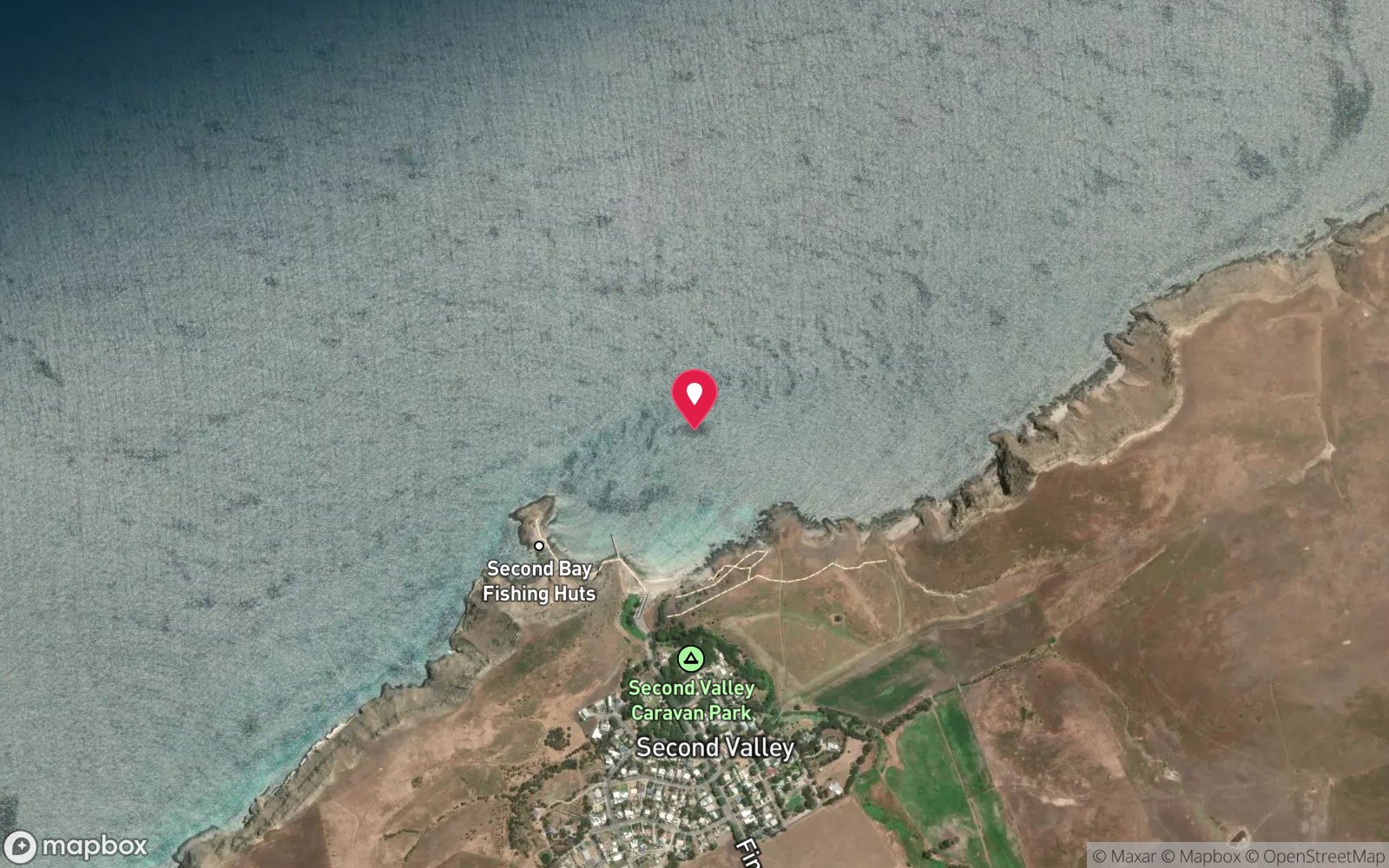
Circular dome-shaped limestone reef about 50 m across, rising from 8 m sand to about 2-3 m, surrounded by seagrass, 200-300 m north-east of Second Valley beach.
Second Valley is about 1 hour 20 minutes (92 km) south of Adelaide via Main South Road; turn right at the Second Valley sign and follow the road down to the beach. Park at the end of the access road (limited spaces; busy on summer weekends); there are public toilets and a changing room but no drinking water. From the centre of the beach, swim about 300 m north (or 200 m north-east of the jetty).
The reef is tricky to find: the Marine Life Network suggests lining up the telephone pole with the left-hand corner of the toilet block as a transit. The swim is strenuous in full gear, so a surface marker and good fitness are needed. Boats can reach it from Wirrina Cove (Marina St Vincent) or Sunset Cove.
Entry: Beach entry and long surface swim, or boat
Facilities: Second Valley car park, toilets and changing room (no drinking water); caravan park and cafe.
Weather, swell & tides
Second Valley faces north-west into the gulf. It is sheltered from southerly and south-easterly weather and best in easterlies, but it is very exposed to northerly through westerly winds and swell and is not diveable in a big swell. Summer and autumn mornings, before the south-westerly sea breeze, are most reliable.
Tidal currents are small inside the bay but can be felt off the headland. Visibility is often good in calm weather and drops after westerlies and rain. Lasseter's is very exposed and not safe in a big swell.
Best season: Late summer to autumn (February-May) for the calmest mornings and best visibility; winter can be clear on easterly days
If it's blown out
Sheltered or shore sites within 25 km that often work when Lasseter's Reef doesn't.
- Rapid Bay Jetty · 3 km · Max 10 m
- Second Valley Jetty · 0 km · Max 5 m
- Second Valley · 1 km · Max 9 m
- Old Rapid Bay Jetty · 4 km · Max 12 m
How the dive is usually run
Swim out on the surface using the transit, descend on the reef and circle it at 5-8 m, then spiral up to the top at 2-3 m. Search the surrounding seagrass edges for leafy seadragons before swimming back to the beach.
Marine life
- Leafy seadragons (resident in adjacent weed) →
- blue devilfish →
- eels
- King George whiting
- silver drummer
- tommy ruff
- wrasse
- magpie perch
- leatherjackets
- mixed kelp
Linked species have their own page listing every site where they are recorded. All marine life →
Training required
Shallow enough for snorkellers and for a first dive under supervision. Any certified diver can dive it.
Courses that help here
- Drysuit Diver – Cold water; locals dive dry for much of the year.
- Peak Performance Buoyancy – Silt and low visibility punish poor trim.
Depth tiers: 0–10 m easy · to 18 m Open Water · 18–30 m Advanced (25 m+ is a deep dive) · 30–40 m Deep specialty · 40 m+ technical. All courses
Hazards & warnings
Long strenuous surface swim (about 300 m) – surface marker essential; hard to locate; very exposed – not safe in big swell; silt reduces visibility if disturbed; boats; protected seadragons.
Dive centres that go here
Club and shop shore dives from Adelaide (Underwater Sports, Diving Adelaide) occasionally; mostly independent divers.
Operators recorded for Lasseter's Reef
Adelaide Scuba
ListedGlenelg North · Adelaide Metro · SA
An Adelaide business providing training, equipment and local diving support, located near Glenelg.
adelaidescuba.com.au · (08) 8294 7744
Diving Adelaide
ListedMarleston · Adelaide Metro · SA
An Adelaide training and guided diving operation serving local sites and organised trips.
divingadelaide.com.au · (08) 8122 5003
Underwater Sports
ListedHolden Hill · Adelaide Metro · SA
An Adelaide equipment and service business. Retail range and servicing capability require verification.
underwatersports.com.au · (08) 8263 3337
Other dive centres in Fleurieu Peninsula & Victor Harbor
The Dive Shack
ListedGlenelg · Adelaide Metro · SA
An Adelaide business combining retail, servicing and training for South Australian divers.
thediveshack.com.au
Divers Delight
ListedStepney · Adelaide Metro · SA
An Adelaide dive business. Retail range, servicing and training availability require verification.
diversdelight.com.au · (08) 8363 7518
Adelaide Technical Diving
ListedPark Holme · Adelaide Metro · SA
An Adelaide operation specialising in technical diving training, relevant to divers preparing for deep, decompression or cave diving in South Australia.
Sea Dragon Dive Lodge
Named by sitesSecond Valley · Fleurieu Peninsula & Victor Harbor · SA
seadragondivelodge.com.au · 0499 229 053
Map
7 pinned sites. Pins marked approximate on their pages show the general area only; not for navigation.
Satellite views
Lasseter's Reef: frequently asked questions
How deep is Lasseter's Reef?
Lasseter's Reef reaches a maximum depth of 8 m, with the shallowest part at about 2 m; most of the dive is spent around 6 m.
What certification do I need to dive Lasseter's Reef?
Open Water is the recommended minimum. Rated intermediate because of cold water.
Can I shore dive Lasseter's Reef?
Yes. Lasseter's Reef is a shore dive that can be done independently: beach entry and long surface swim, or boat.
When is the best time to dive Lasseter's Reef?
Late summer to autumn (February-May) for the calmest mornings and best visibility; winter can be clear on easterly days.
What marine life will I see at Lasseter's Reef?
Regularly recorded: Leafy seadragons (resident in adjacent weed), blue devilfish, eels, King George whiting, silver drummer, tommy ruff, wrasse, magpie perch, leatherjackets, mixed kelp.
What wetsuit do I need at Lasseter's Reef?
7 mm wetsuit with hood year-round; drysuit popular in winter (June-September).
How cold is the water at Lasseter's Reef?
Typically 19-23 °C in summer and 12-14 °C in winter.
What are the main hazards at Lasseter's Reef?
Long strenuous surface swim (about 300 m) – surface marker essential; hard to locate; very exposed – not safe in big swell; silt reduces visibility if disturbed; boats; protected seadragons. See the hazards section above for the full list.
Where is the nearest recompression chamber to Lasseter's Reef?
Royal Adelaide Hospital Hyperbaric Medicine Unit (Adelaide CBD); DAN emergency hotline 1800 088 200. In an emergency call 000, then DAN Asia-Pacific on 1800 088 200.
Diving in Fleurieu Peninsula & Victor Harbor
The Fleurieu is where you go to see a leafy seadragon. Rapid Bay Jetty is the most reliable site anywhere, and Second Valley, the Bluff at Victor Harbor and Port Noarlunga are close behind. The ex-HMAS Hobart, a 133 m destroyer scuttled off Yankalilla in 2002, is the region's flagship boat dive, and the granite coves of Second Valley and Carrickalinga are easy shore dives.
Getting there: An hour or two south of Adelaide. Rapid Bay and Second Valley are walk-in shore dives; the Hobart is a charter from Wirrina Cove or Adelaide.
All Fleurieu Peninsula & Victor Harbor dive sites and a suggested itinerary →
Sources
Nearby dive sites
More shore dives in South Australia
Explore more
This region
Similar dives