Dive slate · divesites.com.au · printed 8 Nov 2026
SS Bombo
Wollongong & Kiama, New South Wales · near Port Kembla / Wollongong
| Depth | 26–32 m |
|---|---|
| Minimum level | Deep/Advanced + experience |
| Difficulty | Advanced |
| Access | Boat |
| Entry | Giant stride or back roll from boat; descend the anchor line (anchoring prohibited during ship movements) |
| Current | Moderate |
| Visibility | 5-15 m |
| Water | summer 19-23 °C, winter 14-17 °C |
| Suit | 5–7 mm wetsuit with hood in summer–autumn; 7 mm semi-dry or drysuit June–October |
| Best season | Late autumn to early winter for visibility and calm westerly seas |
| Bottom time | 20 min |
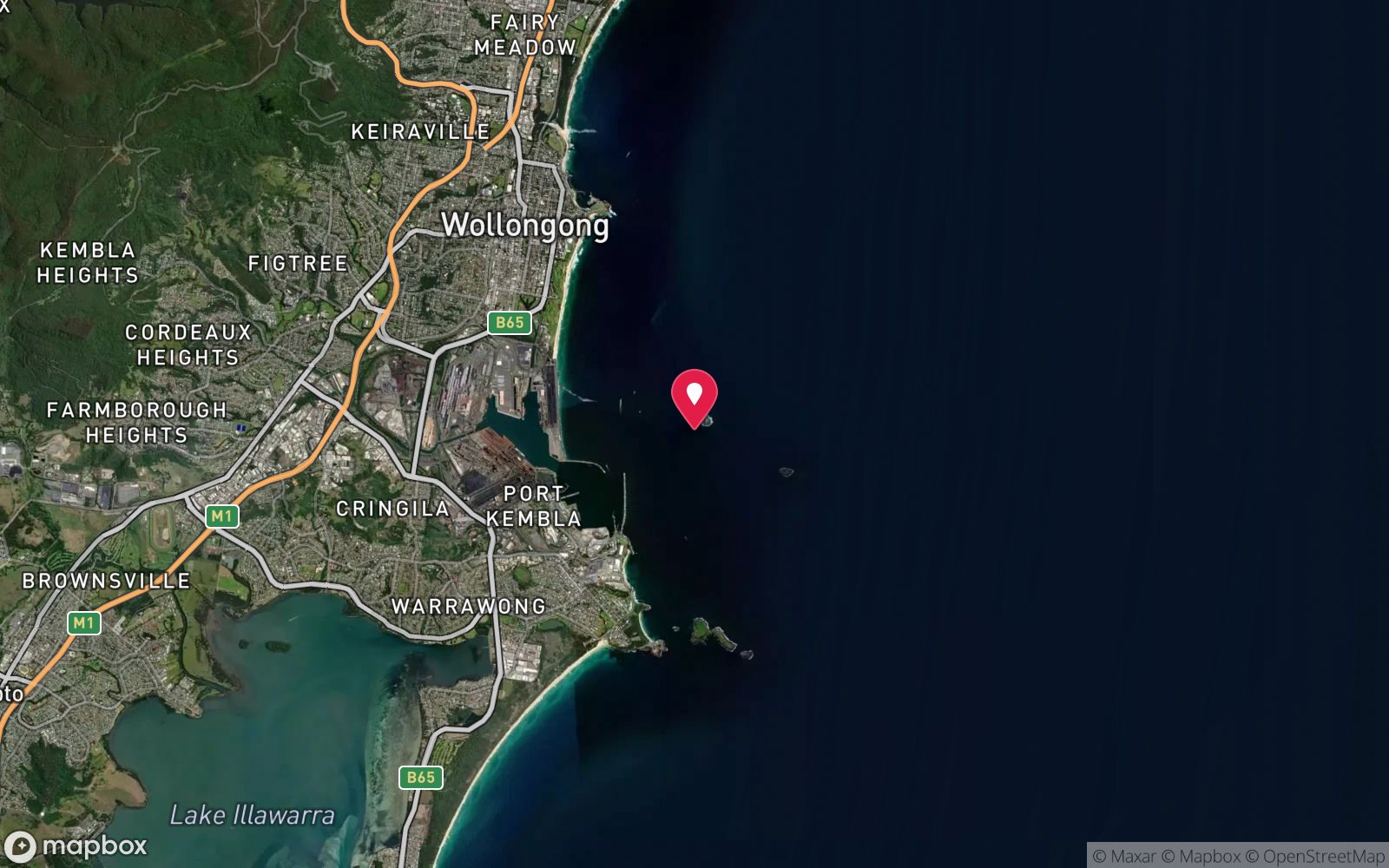
| Position | -34.44467, 150.92577 (GPS) |
| Permit | None required (not in a marine park); anchoring near the shipping channel is restricted during vessel movements. |
| Nearest chamber | Prince of Wales Hospital (Randwick, Sydney) – approx. 1.5 h by road from Wollongong/Shellharbour; call 000 and DAN Asia-Pacific hotline |
| Emergency | 000 · DAN Asia-Pacific diving emergency 1800 088 200 |
SS Bombo
Also known as HMAS Bombo, Bombo wreck
Upturned 46 m collier broken open by storms, with an exposed triple-expansion engine, boiler and a separated upright stern carrying the propeller. The Illawarra's signature wreck dive.
Near Port Kembla / Wollongong · Wollongong & Kiama, New South Wales
- Depth
- 26–32 m
- Minimum level
- Deep/Advanced + experience
- Access
- Boat
- Boat ride
- ~15 min
- Water
- 19-23 °C
- Visibility
- 5-15 m
SS Bombo26–32 m · Deep/Advanced + experience
Dive factsDepths, conditions, location & safety
Season
Off-peak nowBest months: March, April, May, June, July, August.
Late autumn to early winter for visibility and calm westerly seas
- Best months
- Now (November)
Dive facts
- Depth
- 26–32 m
- Typical depth
- 30 m
- Certification
- Deep/Advanced + experience
- Difficulty
- Advanced
- Depth tier
- Deep / Advanced + experience (30–40 m)
- Access
- Boat
- Offshore
- 2.5 km
- Dive centre needed
- Yes – boat access only
- Shore / independent
- No
- Boat ride
- ~15 min
- Current
- Moderate
- Visibility
- 5-15 m
- Water temp (summer)
- 19-23 °C
- Water temp (winter)
- 14-17 °C
- Water
- Temperate
- Bottom time
- 20 min
- Dive traffic
- Moderate (occasional charters/club dives)
- Night dive
- No
- Snorkel friendly
- No
Exposure suit
5–7 mm wetsuit with hood in summer–autumn; 7 mm semi-dry or drysuit June–October
Location
Port Kembla approaches · Illawarra – Wollongong & Port Kembla
-34.44467, 150.92577
Published GPS position.
Open in Google MapsPrimary source: michaelmcfadyenscuba.infoMarine park & permits
None required (not in a marine park); anchoring near the shipping channel is restricted during vessel movements.
Nearest recompression chamber
Prince of Wales Hospital (Randwick, Sydney) – approx. 1.5 h by road from Wollongong/Shellharbour; call 000 and DAN Asia-Pacific hotline
Diving emergency: call 000, then DAN AP 1800 088 200.
Trip planner
Build a trip around SS Bombo →
A day-by-day plan for Wollongong & Kiama with this site locked in.
This guide is a planning aid. Conditions change daily — confirm with a local dive centre and dive within your training. Data & safety notes.
Dive profile
How this site rates
Scores are computed from the recorded data, not opinions. How?
At a glance
SS Bombo is a wreck boat dive in Wollongong & Kiama, NSW, 26–32 m, suited to Deep/Advanced + experience divers, moderate current, about 15 minutes by boat.
Rated advanced because of depth to 32 m, boat traffic overhead, wreck penetration options that need training, cold water.
Why dive here
- Upturned 46 m collier broken open by storms, with an exposed triple-expansion engine, boiler and a separated upright stern carrying the propeller. The Illawarra's signature wreck dive.
- Sunk in 1949; protected as underwater cultural heritage, so look but do not touch.
Conditions to avoid
- Afternoon north-easterlies
- Outgoing tide or run-off after rain (poor visibility)
About SS Bombo
The SS Bombo is the best-known wreck of the Illawarra and one of the more poignant. Built in 1929 by H. Robb at Leith in Scotland, the 46 m, 540-ton steel collier spent the 1930s carrying crushed blue metal from the Kiama quarries to Sydney. From 1941 to 1946 she served as the auxiliary minesweeper HMAS Bombo before returning to the stone trade. At about 10 pm on 22 February 1949, loaded with some 640 tons of blue metal, she was caught by a southerly storm about 4 km from Port Kembla; the cargo shifted, she rolled over and sank within minutes. Twelve of her fourteen crew, including Captain Arthur Bell and Chief Engineer Percy Carroll, were lost.
The wreck was located in 1978 by Don Morrison and Bruce Hammond and was then remarkably intact apart from a break in the hull. She lies upside down in 32 m, roughly north–south, on a sand bottom. Storms, especially a major one in 1996, have changed her dramatically: the hull has split open and the stern has broken away and now sits upright on the seaward side, carrying the propeller with one blade snapped off. The collapse has exposed the inverted engine – pistons, conrods and driveshaft are easy to see – and the boiler can be viewed from both sides of the hull. Along the sides lie the hopper, a bollard, pieces of hatch cover and the rudder. The bow still shows scarring from the sinking.
Penetration, once possible through several openings, is now limited and unwise because of the unstable structure. The wreck attracts schools of yellowtail and bullseyes, with nannygai, wobbegongs, red morwong and moray eels around the debris. The combination of depth, variable visibility and commercial shipping means this is a dive for experienced divers who can manage a short bottom time and a clean ascent in open water. It is also a war grave in spirit if not in law – treat it with respect.
Wreck details
Steel steam collier (ex-HMAS Bombo auxiliary minesweeper), 46 m, 540 tons, built 1929 Leith · Sunk 1949 · Protected historic shipwreck
Era: post-war. Oldest wrecks · Wartime wrecks · Scuttled warships
Other wrecks of the same era
- SS Empire Gladstone · Max 12 m · Merimbula
- MV Fairwind wreck · Max 87 m · South West Rocks
- SS Kiama wreck · Max 47 m · Central Coast
- SS Paterson wreck (Cabbage Tree Bay area) · Max 10 m · Central Coast
- LVT-4A amphibious tank (Stockton Beach) · Max 33 m · Newcastle & Lake Macquarie
- Olive Cam · Max 9 m · Eden & Green Cape
Getting there & entry
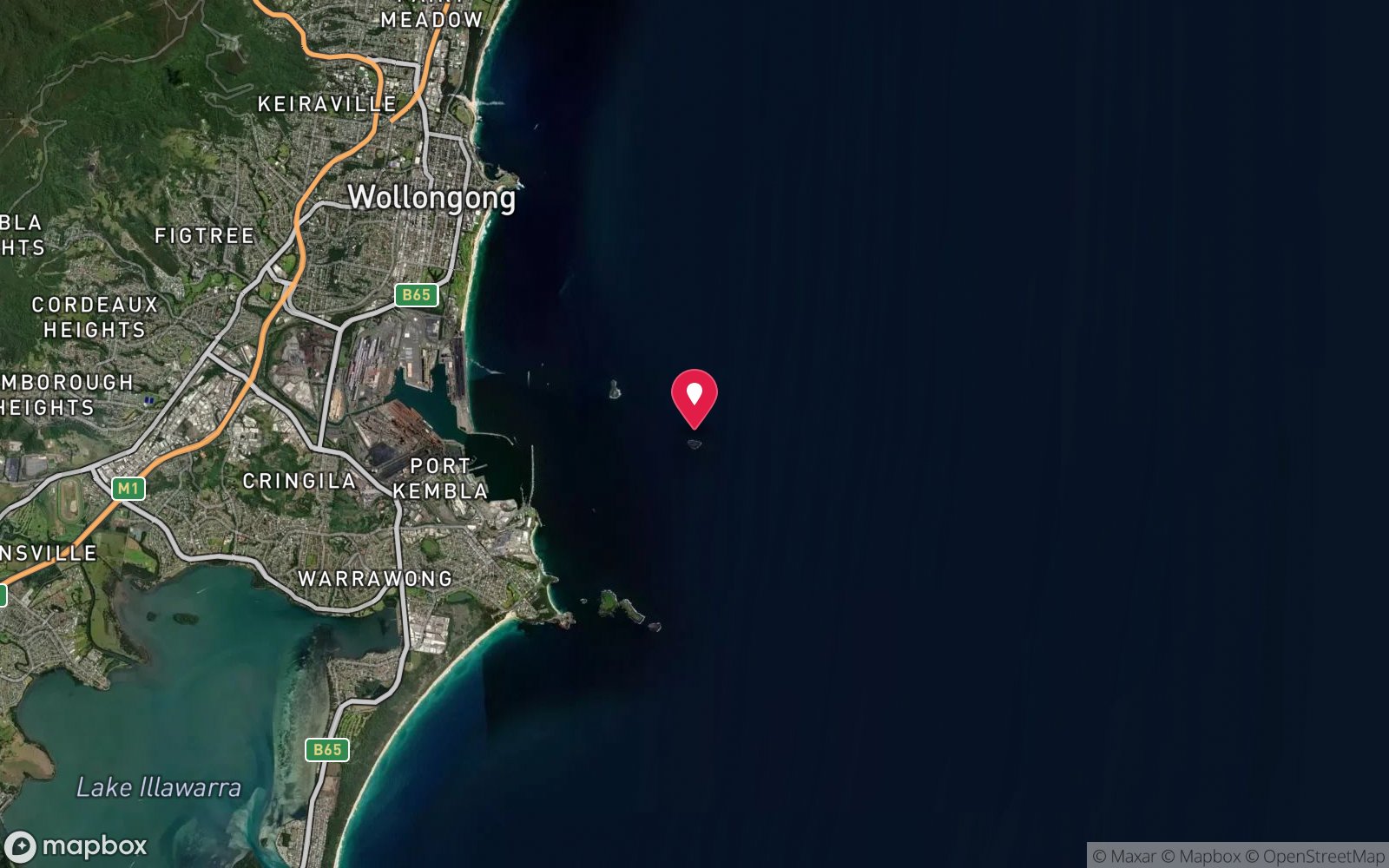
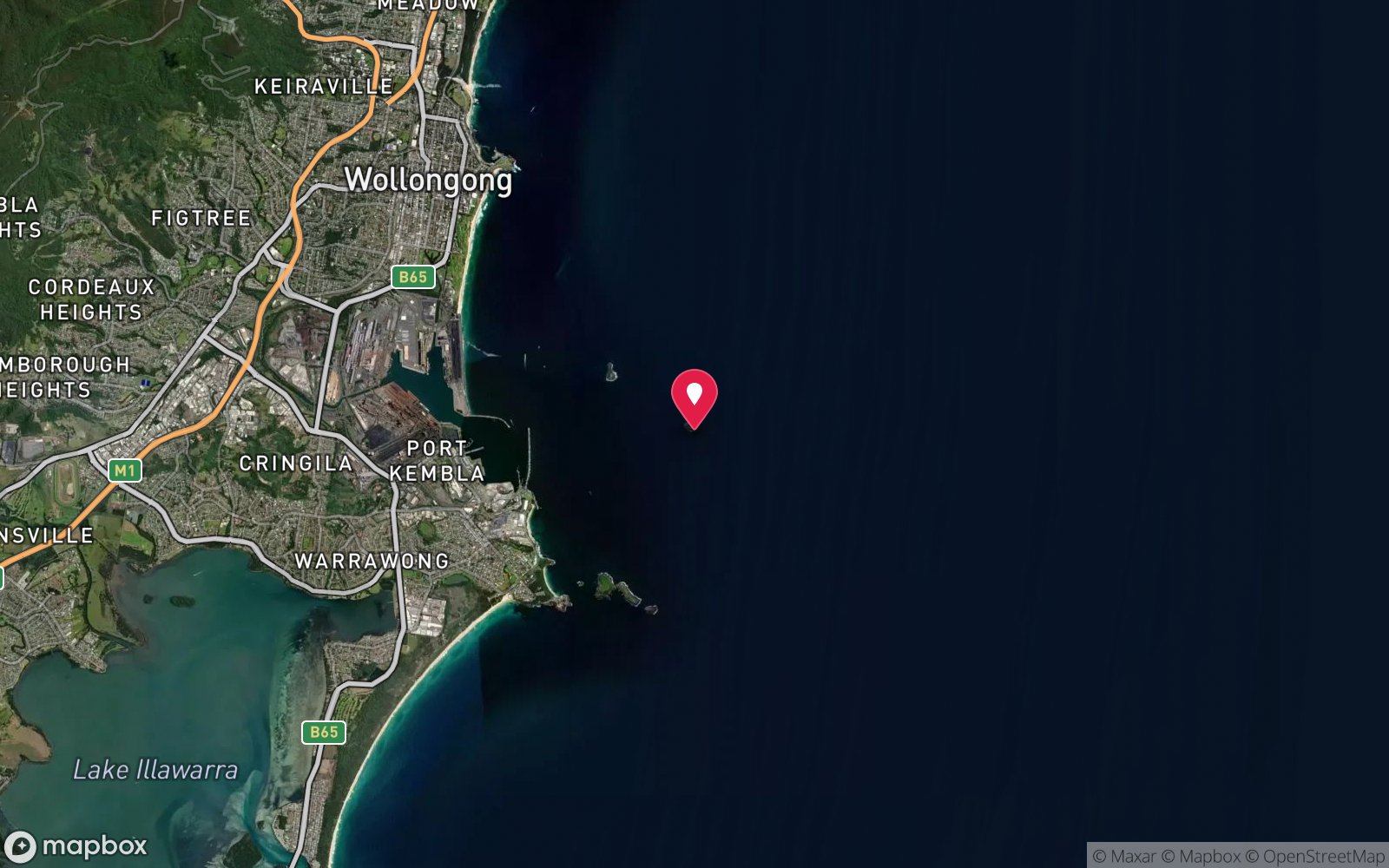
Inverted steel collier lying in 32 m about 4 km from the Port Kembla harbour entrance and roughly 2.5 km off Wollongong's southern beaches, right beside the shipping approach.
Launch from the Port Kembla boat ramp in the Outer Harbour (behind the steelworks; large car and trailer park, toilets). Wollongong Harbour's ramp (Belmore Basin) is closer to the northern islands but suits only small boats in calm seas. From Port Kembla steer out through the harbour entrance, keeping clear of the shipping channel, and head for the island; the run is 10–15 minutes in a small boat.
The wreck is a short run north-east of the harbour entrance on GPS 34° 26.680' S 150° 55.546' E. Before leaving the ramp phone the Port Kembla port duty officer to confirm no ships are due in or out during your dive window – large bulk carriers pass very close to the site. United Divers in Wollongong can advise on current marks and arrangements.
Entry: Giant stride or back roll from boat; descend the anchor line (anchoring prohibited during ship movements)
Facilities: Port Kembla Outer Harbour boat ramp: large trailer park, toilets. Air fills at United Divers (Fairy Meadow) and Shellharbour Scuba.
Weather, swell & tides
Open coast site exposed to swell from the north-east through south; wants a swell under about 1.5 m and light winds for a comfortable anchor-up. Visibility on the wreck is notoriously variable and often does not match surface conditions – it can be 5 m on a glassy day and 15 m after a blow. An incoming tide is generally preferred, although tide is rarely critical.
After heavy rain, dirty water from Port Kembla harbour and Lake Illawarra can reduce visibility. The overriding constraint is shipping: dive only in a gap between vessel movements.
Best season: Late autumn to early winter for visibility and calm westerly seas
If it's blown out
Sheltered or shore sites within 25 km that often work when SS Bombo doesn't.
- Bass Point Gravel Loader · 16 km · Max 12 m
- Bushrangers Bay · 17 km · Max 20 m
- The Gutter (Bass Point) · 17 km · Max 20 m
- Flagstaff Point · 3 km · Max 12 m
How the dive is usually run
Anchor near the stern and descend to the engine and boiler area. Work along the eastern side of the inverted hull inspecting the 1996 storm damage, visit the broken-off stern section which now sits upright with the propeller (one blade missing), then return up the western side past the scattered hopper, bollard and hatch-cover pieces. Finish on top of the hull before ascending the anchor line; on air expect 15–20 minutes before decompression.
Marine life
- Yellowtail
- bullseyes
- nannygai
- red morwong
- wobbegong sharks →
- moray eels
- stripey
- sergeant baker
- nudibranchs →
- sponges
Linked species have their own page listing every site where they are recorded. All marine life →
Training required
The recreational limit. Operators expect a Deep Diver specialty or Advanced plus a log of similar dives, and most recommend nitrox.
This is a deep dive: plan gas, bottom time and a safety stop accordingly, and consider nitrox.
Courses that help here
- Enriched Air Nitrox – Longer no-decompression time at 25 m and deeper.
- Deep Diver – The site reaches 32 m.
- Wreck Diver – The wreck has penetration options.
- Drysuit Diver – Cold water; locals dive dry for much of the year.
Depth tiers: 0–10 m easy · to 18 m Open Water · 18–30 m Advanced (25 m+ is a deep dive) · 30–40 m Deep specialty · 40 m+ technical. All courses
Hazards & warnings
Lies beside the Port Kembla shipping approach – confirm ship movements with the port duty officer before diving and never dive while a vessel is moving; depth 32 m limits no-deco time on air; collapsing structure and entanglement risk – do not penetrate; variable visibility and occasional current; open-water ascent.
Technical notes
Nitrox (EAN28–30) extends no-decompression time usefully. Structure is unstable – no penetration.
Dive centres that go here
United Divers (Wollongong) runs occasional boat trips when shipping and weather allow; otherwise dived from private and club boats (Sydney clubs make regular trips). No daily charter.
Operators recorded for SS Bombo
Shellharbour Scuba and Photography Centre
Named by sitesShellharbour · Wollongong & Kiama · NSW
shellharbourscuba.com.au · (02) 4296 4266
United Divers
Named by sitesFairy Meadow · Wollongong & Kiama · NSW
Directory profile (22 Princes Hwy Fairy Meadow) shows trading hours but is unclaimed; the website serves an expired certificate and no dated 2025–26 activity was found.
uniteddivers.com.au · +61 2 4228 5962
Other dive centres in Wollongong & Kiama
Shellharbour Scuba
ProfiledShellharbour · Wollongong & Kiama · NSW
A Shellharbour Village dive shop giving access to Bass Point and Bushrangers Bay, teaching SDI and TDI courses from beginner to technical levels.
shellharbourscuba.com.au · +61 2 4296 4266
Dive Near Me (formerly Windang Dive & Spearfishing)
Named by sitesWindang · Wollongong & Kiama · NSW
Now trading as Dive Near Me at the same address.
divenearme.com.au · (02) 4262 1463
Expedition Dive
Named by sitesSydney · Wollongong & Kiama · NSW
Online booking desk only, no retail shop; runs Sydney and South Coast dives.
expeditiondive.com.au · 1800 463 483
Map
7 pinned sites. Pins marked approximate on their pages show the general area only; not for navigation.
Satellite views
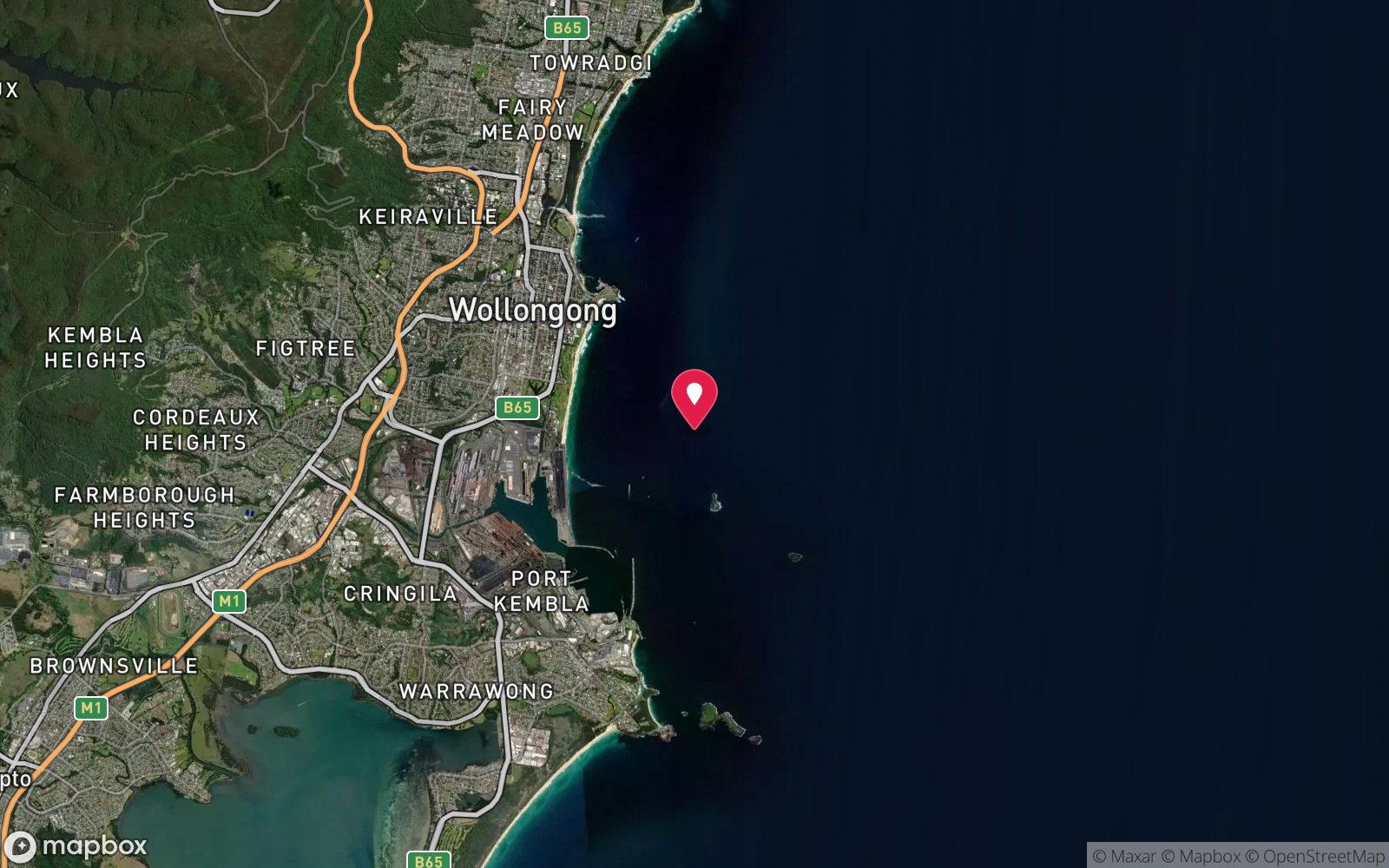
SS Bombo: frequently asked questions
How deep is SS Bombo?
SS Bombo reaches a maximum depth of 32 m, with the shallowest part at about 26 m; most of the dive is spent around 30 m.
What certification do I need to dive SS Bombo?
Deep/Advanced + experience is the recommended minimum. This is a deep dive: plan gas, bottom time and a safety stop accordingly, and consider nitrox. Rated advanced because of depth to 32 m, boat traffic overhead, wreck penetration options that need training, cold water.
Can I shore dive SS Bombo?
No, it is reached by boat (about 15 minutes). A dive centre is required: boat access only.
When is the best time to dive SS Bombo?
Late autumn to early winter for visibility and calm westerly seas.
What marine life will I see at SS Bombo?
Regularly recorded: Yellowtail, bullseyes, nannygai, red morwong, wobbegong sharks, moray eels, stripey, sergeant baker, nudibranchs, sponges.
What wetsuit do I need at SS Bombo?
5–7 mm wetsuit with hood in summer–autumn; 7 mm semi-dry or drysuit June–October.
How cold is the water at SS Bombo?
Typically 19-23 °C in summer and 14-17 °C in winter.
What are the main hazards at SS Bombo?
Lies beside the Port Kembla shipping approach – confirm ship movements with the port duty officer before diving and never dive while a vessel is moving; depth 32 m limits no-deco time on air; collapsing structure and entanglement risk – do not penetrate; variable visibility and occasional current; open-water ascent. See the hazards section above for the full list.
Where is the nearest recompression chamber to SS Bombo?
Prince of Wales Hospital (Randwick, Sydney) – approx. 1.5 h by road from Wollongong/Shellharbour; call 000 and DAN Asia-Pacific hotline. In an emergency call 000, then DAN Asia-Pacific on 1800 088 200.
Diving in Wollongong & Kiama
Between Sydney and the Shoalhaven the Illawarra coast has a quiet collection of shore reefs, rock platforms and boat dives. Bass Point at Shellharbour is the standout, a marine reserve with the Gutter, the Arch and a resident population of blue gropers and Port Jackson sharks; Kiama's Cathedral Rocks and Bushrangers Bay are also worth the drive.
Getting there: Ninety minutes south of Sydney. Bass Point and Bushrangers Bay have car parks and rock or beach entries; Wollongong and Shellharbour shops run occasional boat dives.
All Wollongong & Kiama dive sites and a suggested itinerary →
Sources
- michaelmcfadyenscuba.info/viewpage.php?page_id=81
- gooddive.com/diving-australia/wollongong-diving.htm
Data confidence: High · Being verified: Port duty officer phone numbers change – check current Port Kembla port control contact before publishing.. Last updated September 2026. Know this site better? How to send a correction
Nearby dive sites
More wrecks in New South Wales
Explore more
This region
Similar dives